Swan Dive
Project 2026: The Two Most Powerful Men In Washington

April 29, 2026 • 6 minute, 40 second read
This morning, the Senate Banking Committee advanced Kevin Warsh’s confirmation for Federal Reserve chairman on a 13-11 vote, with Senator Thom Tillis stepping aside after the Justice Department closed its investigation into Jerome Powell.
The nomination now heads to the full Senate, where the final vote will decide whether Warsh takes the position.
That procedural step lands in the middle of a larger shift already underway.
Treasury Secretary Scott Bessent is managing issuance, liquidity and the government’s balance sheet. If confirmed, Warsh would control the price of credit.
Between them, they would sit on both sides of the same equation — how much money enters the system and what it costs to borrow it.
🧭 The Great Resource Race Is Already Underway
The contest with China begins with inputs that don’t show up on a balance sheet until they’re missing — rare earths, energy, industrial metals and the infrastructure required to move them.
China has spent years securing supply through long-term contracts, domestic production and state-backed financing. It has also built out power generation capacity at a scale that allows it to run energy-intensive industries without interruption.
The United States is approaching the same constraint through capital markets. Private investment funds the buildout. Energy producers respond to price. Infrastructure expands as financing becomes available.
Both systems aim to solve the same problem: who can keep the lights on and the machines running when demand spikes.
⚙️ Two Desks, Ane Problem
Bessent has described a “3:3:3” framework — 3% growth, a deficit moving toward 3% of GDP and interest rates anchored near 3%. That framework assumes the Treasury can continue issuing debt at a pace markets will absorb while growth remains steady.
Warsh has argued for coordination between the Treasury and Fed, similar to the 1951 Accord, in which each institution operates independently while sharing a common understanding of the broader objective.
Treasury manages supply and liquidity. The Fed sets the price of money.
Together, the arrangement aims to keep borrowing costs contained while capital continues to flow into productive investment.
📉 Households Are Already Feeling It
The pressure shows up first in household budgets. Energy prices rise and feed into transportation, food and utilities. Borrowing costs affect mortgages, auto loans and credit cards.
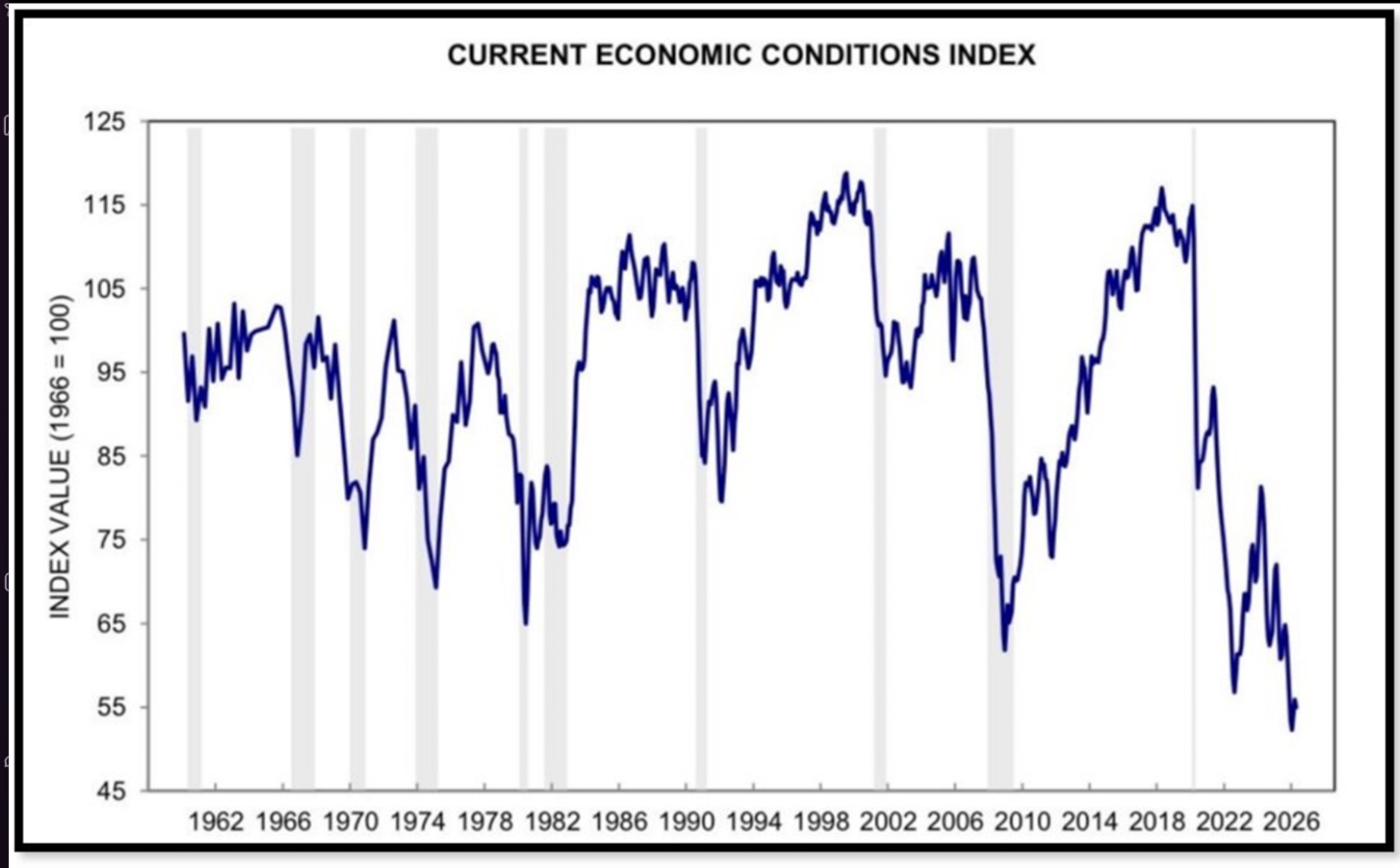 Plummeting economic conditions help make Warsh’s case for one or two rate cuts in 2026. Then, his argument goes, the Fed needs to get out of the business of picking winners and losers in a capitalist economy… and quit being the “lender of first resort” preempting banking and financial crises. (Source: Tavi Costa on X)
Tavi Costa put it rather bluntly on X this morning:
“It’s wild to see markets still pricing in zero Fed rate cuts with this economic index at its worst level in nearly 70 years.
I believe we’ll see meaningful cuts over the next two years.
Counterintuitively, the war only strengthens the case for lower rates.
Military spending is accelerating, the cost of debt has already surged, and recession risks are materially higher than they were just six months ago. And if your argument is that tighter conditions are needed to fight inflation, I have news for you…
This is not the 1970s. The Fed has zero ability to do anything meaningful to contain inflation.
Growth is slowing, but debt isn’t.”
Military spending adds to federal outlays. Debt service rises alongside it. Households feel the cost through higher prices and higher interest rates simultaneously.
📊 Money Is Still Flowing Big Into The AI Buildout
At the same moment, large technology firms are reporting earnings and detailing capital spending plans for data centers, chips and power infrastructure. Those investments require long timelines and high upfront costs.
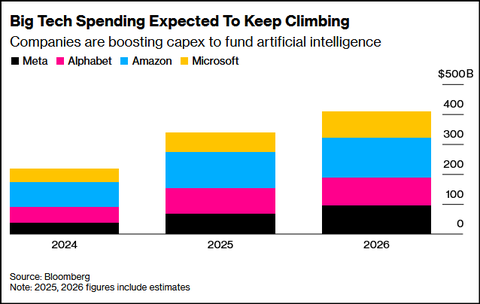
Big Tech isn’t slowing down on AI — it’s accelerating. From trillion-dollar infrastructure plans to record-breaking chip orders and data center expansion, the race to dominate artificial intelligence is becoming the biggest spending boom the tech sector has seen in decades. (Source: Bloomberg)
Electricity demand rises as data centers come online. Construction requires steel, copper and skilled labor. Financing depends on interest rates remaining manageable.
The same system that funds the buildout also sets the cost of every input going into it.
🕰️ The Election Clock
November 3, 2026 is fixed. Voters will decide control of the House on that date.
It’ll either keep Mike Johnson, a Trump loyalist, in as House Speaker. Or if the Democrats gain the majority, Hakeem Jeffries will assume the leadership role and determine the bills that get called to a floor vote.
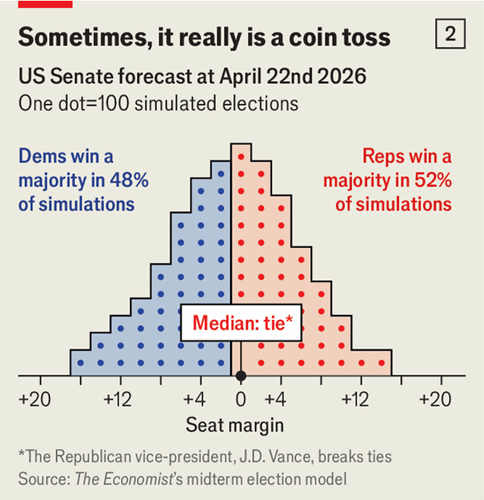
The battle for Congress is shaping up to be razor-thin. With narrow margins, deep political divides and billions already flowing into key races, the 2026 midterms could come down to just a handful of districts. (Source: The Economist)
Jeffries is no fan of President Donald Trump. And you can bet the first slate of bills that will be brought to the floor will be a list of grievances they have against the Trump administration and will result in efforts to impeach the President. Again.
And then again. And again.
The legislative wheel will grind to a halt.
The Trump clan doesn’t want to see that happen, do they? So that puts the pressure on them to get their policy changes passed and enacted and to make voters “feel” the benefits of lower taxes, fewer regulations and cheaper borrowing costs. That time frame must also specify how actively they’re engaged in Iran and how they’ll bring down fuel and energy costs.
Policy changes, capital investment and energy supply adjustments take a long time to register with voters. So, the administration is pushing multiple initiatives forward at once because the effects need to be visible before the vote.
Since 1946, the president’s party has lost House seats in 18 of 20 midterm elections, averaging roughly 28 seats. Tariffs, inflation and war spending have historically put more pressure on voters than relief.
📚 The Old System, Rewired
The post-1989 global system prioritized efficiency. Production moved to lower-cost regions. Supply chains stretched across continents. Capital flowed freely.
That system depended on stable energy supplies and predictable geopolitical conditions. Both are now under strain. Governments are accepting higher costs to secure supply chains and reduce dependency.
Artificial intelligence accelerates the shift. It requires energy, hardware, and coordination at scale. Those inputs are physical, not digital. They cannot be expanded on demand.
🌐 Trump Is Trying To Line Things Up In Real Time
We expect a round of fireworks over the Fourth of July weekend and America’s 250th Anniversary. But the real prize lies beyond the electoral calendar.
The U.S. model for AI buildout and use relies on capital markets to allocate resources. Investors decide where money flows. Companies build where returns justify the cost.
China’s model directs resources through state planning, coordinating energy, production and financing from the top down.
Bessent and Warsh are trying to line up fiscal policy, monetary policy, and market incentives so capital continues to flow into energy, infrastructure, and technology at the same time.
The vote in the Senate determines who sets the price of money. Treasury auctions determine who buys the debt. Energy markets determine what it costs to run the system that those two men are trying to manage.
And time’s getting short.
~ Addison
P.S. Tomorrow, Grey Swan Live! returns with a new guest: Jeff Opdyke.
Jeff is a former Wall Street Journal writer who has made the move to not just heavily investing overseas, but living overseas as well. Today, he’s the editor of the Global Intelligence Letter.

We’ll talk with Jeff about how he made his move overseas, why he’s focused on international investing, and some of the top foreign markets for investors today.
And if you missed last week’s Grey Swan Live! with Zoltan Istvan, we got a whirlwind view of the future, Zoltan-style, which we dubbed “Robots, UBI, and Wine”…
Plus, last week on Grey Swan Live!, we also showcased our latest research on Shadow Stocks – volatile stocks that move rapidly up and down beneath the surface of the calm indexes.