Beneath the Surface
“It’s The Economic Vibe, Stupid” and Other Meaningless Comments

January 7, 2025 • 7 minute read

“God spared my life for a reason. And that reason was to save our country and restore America to greatness. We will fulfill that mission together.”
–Donald J. Trump
January 7, 2025— “I have long appreciated your insights on sound money, limited government, and the critical role of individual responsibility in preserving liberty,” writes frequent correspondent Scott P. opening with civility like another patron at an Irish Pub. “Your critiques of government overreach and special interests often strike a chord with me.”
“Yet,” Mr. P continues neatly donning whiskey gloves, “I find myself troubled by your apparent support—or at least tolerance—for Donald Trump and the Republican Party’s claims of reducing government, restoring rights, and championing constitutional principles.”
From there, the gentleman’s critique of Trump’s impending return to power reads like this:
Faith in Trump and his associates is not only misplaced but dangerously at odds with the values you champion. Consider the following:
Government Growth and Debt Accumulation: The federal government did not shrink during Donald Trump’s presidency. Instead, it grew in scope and influence, and Trump accumulated nearly one-third of the U.S. federal debt during his 4-year tenure. This is not the hallmark of fiscal conservatism. It is, however, consistent with a system that prioritizes enriching the powerful at the expense of the governed.
Hierarchy and Power Concentration: For nearly a century, Americans have consistently concentrated power in government, often under the guise of addressing special interests. Yet, this has primarily served to benefit those closest to power—the wealthy and the connected. This pattern is neither new nor unique to one political party. It reflects a hierarchy deeply ingrained in organized society, where the masses serve the interests of a ruling class.
Trump’s Self-Enrichment and Betrayal of Constitutional Principles: Donald Trump’s actions primarily focus on self-enrichment and self-preservation. His rhetoric and policies have undermined trust in our institutions, culminating in an unprecedented attack on the U.S. Capitol. His calls for retribution against those who upheld constitutional principles against his will—including calls for executions—are a stark betrayal of the very ideals that conservatives claim to defend.
“Trump’s win signals to all Americans: violence is the answer.” Scott then hones his message:
Addison, you know as well as I do that neither party has lived up to the principles of limited government and sound money. However, to view Trump as a corrective force means ignoring his record and the broader pattern of governance that has enriched elites while marginalizing the electorate.
We, the people, are not blameless. We have empowered this hierarchy, often through apathy, division, and an unwillingness to confront uncomfortable truths. The federal government is an edifice of special interests, built and maintained by our choices. Recognizing this complicity is the first step toward meaningful change.
I urge you to reconsider any tacit or explicit support for Donald Trump and his enablers. The values of limited government and individual liberty demand a principled stance that rejects autocratic tendencies, self-serving oligarchs, and the continued concentration of power.
Since we’re hopping up on the soap box, let me come clean.
The late PJ O’rourke, whose 2010 book, “Don’t Vote-It Just Encourages The Bastards,” sums up my view on American politics. In other words, I’m a pragmatic political nihilist.
I haven’t voted since 1988 when I briefly succumbed to peer pressure and went to the poll with a group of college friends. I’ve regretted it ever since.
It’s not a popular position in my family. My father, may he rest in peace, was a staunch old-school New England local government advocate who served for several years as the Sergeant At Arms of the New Hampshire State Senate. My mother, who just turned 80, can lay down a blue-stitch-laden civic duty lesson with the best of them.
As such, I spare her my views on jury duty, as well. More succinctly, which candidate promises sound money, low taxes, limited government, a civilized global footprint, a balanced budget, term limits and an independent judiciary?
That said, Trump’s political tactics are bizarre. And he’s not exactly the most articulate dude. Yet 77 million people are more than happy, for now, filling in the blank spaces between his ad hominem attacks on anyone who appears to disagree with him with their own version of what MAGA means.
“Trump Will Fix It” is an equally dangerous populist rallying cry as anything the knuckleheads on the left have come up with. This chart tells the story:
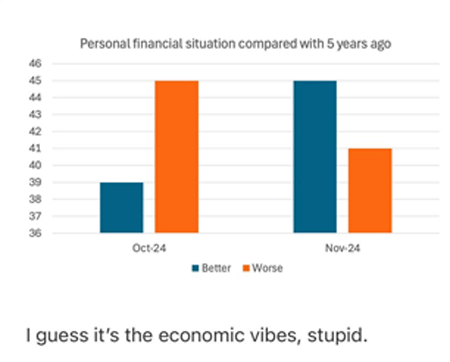
“Biden broke it,” one colleague wrote upon seeing this depiction of the fickle electorate. “Trump fixed it…. without ever doing a thing.”
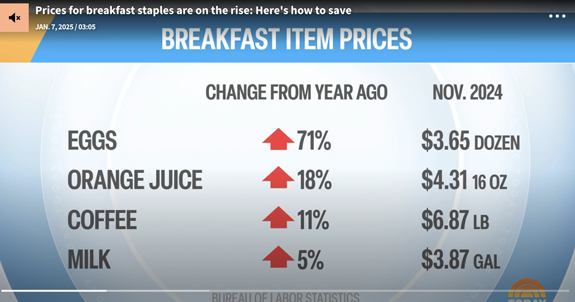
A random report from the Today Show on NBC this morning on basic breakfast food items shows that inflation has done everyything… but go away.
When 77 million people realize that Trump’s plans to, hmm, let’s see, annex Greenland, “reclaim” the Panama Canal, find and deport violent ISIS and Mexican cartel members who come to the country illegally, stunt China’s economic growth with tariffs while onshoring chip manufacturing and encourage energy independence, ending the war in the Ukraine and removing financial support for NATO, remove government inefficiencies by shutting down executive branch agencies are all going to be expensive policies and will take more time than two years to the midterm to implement… well, they aren’t going to be any happier with him than they were with Biden and his election surrogate Harris.
Your point is well taken, Mr. P, as we ourselves have tried to articulate through three successive editions of Empire of Debt, the centralization of power in Washington throughout the 20th Century is anathema to the Republic that Franklin, and his buddies left us with. And is the root cause of both interminably bad policies, foreign and domestic, emanating from both parties.
But who are we to gripe?
“In a country of 330 million people,” Scott P. wraps up, “we can’t find an intelligent person of character to lead the executive branch of our government?”
“Following the track of the Republican and Democratic Parties for the last hundred years, how is it that these criminal gangs have any members at all?
“People join gangs for two reasons: to profit or because they are scared. The answer may be there. However, given that most people say they want ‘good’ government, I can’t figure out why so many people support these corrupt organizations.”
Hear, hear.
Regards,

Addison Wiggin,
Grey Swan
P.S. Our mission in Grey Swan is less MAGA and more Es Lo Que Es (ELQE):

“It is what it is” in Spanish. We made these hats and distributed them to all the workers who were renovating our house leading up to the 2020 election. As you may imagine, we did not ask them for their green cards or country of origin. (Source: Addison Wiggin)
We recognize American politics for what they are. We try to read the tea leaves effectively enough to anticipate what the market can provide and what will happen to our money next. Then, we assemble investment advice for members accordingly. Sign up for our latest research here.
P.P.S. Canadian Prime Minister Justin “Castro” Trudeau has announced that he’s stepping down. The move comes after Trump has talked about buying Canada and making Trudeau the governor of a future 51st state. We can’t help but chuckle at the timing…
Trudeau and Deputy Prime Minister Chrystina Freeland were both graduates of the World Economic Forum (WEF) Young Global Leaders program. And the subject of much ire during the aggressive Canadian lockdown of the economy during the pandemic.
We also note that Pierre Poilievre was listed on the WEF website in 2021, but has since been removed. Poilievere leads Canada’s Conservatives, and PolyMarket sees a 92% chance he will be the next PM.
Long-time readers will recognize we have not been, well, big fans of Klaus Schwab and his acolytes at the WEF. Our latest installment of the critique can be found on the Grey Swan website right here: Milei v. The WEF.
P.P.P.S. As always, you can send your own comments on the Grey Swan here: addison@greyswanfraternity.com
How did we get here? Find out in these riveting reads: Demise of the Dollar; Financial Reckoning Day; and Empire of Debt — all three books are now available in their third post-pandemic editions. You might enjoy one or all three.