Chinese refiners began cutting runs yesterday. The U.S. and Israeli action in Iran has tightened oil supply. And shipping through Hormuz has been disrupted in the short term.
China imports about half its crude from the Middle East. When the Gulf seized up, the pressure showed immediately in Chinese refineries.
According to Reuters, Zhejiang Petrochemical started maintenance on a 200,000-barrel-per-day unit and cut production by 20%. Fujian Refining and Petrochemical halted an 80,000-barrel-per-day unit.
Since 1991, China’s role as the world’s low-cost manufacturer has been driven by a combination of government incentives, massive infrastructure investment, and a highly efficient business ecosystem. While “cheap labor” was the initial catalyst, the country’s enduring advantage now stems from its unmatched scale and integrated supply chains.
The progression of superpowers is remarkably consistent through time. Factories build wealth. Wealth buys diplomatic reach. Diplomatic reach invites military ambition.
The Chinese Communist Party made the strategic decision to join the global economy in 1991. In so doing the party leaders signaled its “glorious” for Chinese communists to aspire to great wealth.
A decade later, in 2001, China was admitted to the World Trade Organization (WTO).
In 2013, Xi Jinping launched the Belt and Road Initiative and pushed Chinese financing across Asia, Africa and Europe. Beijing set up the Asian Infrastructure Investment Bank and widened its role in institutions the West once treated as its own parlor.
The Chinese opened their first overseas military base in Djibouti in 2017.
The Pentagon has since observed that China is fielding the world’s largest navy by ship count. Factory, financing, fleet — China, like great powers of all historical trading empires, means business.
 Beijing Opens Parliament With a Hangover
This week, Beijing has to defend that whole structure with slower growth, a property bust and softer factory activity.
Reuters reported that Premier Li Qiang is expected to set a 2026 GDP target between 4.5% and 5%, potentially the first reduction in four years, while keeping the budget deficit around 4% of GDP and raising special debt issuance. The official PMI is expected to remain below 50, signaling a second month of contraction. A country can still be formidable while coughing. China is coughing.
At the same time, this year’s National People’s Congress is expected to map the next phase of China’s technology push, with attention on AI, humanoids and space.
Beijing knows low-end assembly – cheap labor – is no longer enough. Wages have risen. Vietnam, India, and Mexico are taking bites out of the old labor-cost story. China now needs productivity, higher-end manufacturing and self-reliance in chips and AI to address its nascent political and military ambitions.
 Iran Is Part of the China Story
Against this backdrop, Trump has engaged in a grand realignment of the United States’ role in the global economy, its political alliances, and its military engagements.
Through the Trump grand realignment lens, the moves of the Trump administration all make sense: tariffs, supply chains, manufacturing, taxes and interest rates; Ukraine, NATO, Panama, Greenland, Venezuela…
And Iran.
The grand bargain struck between Trump and Saudi Arabia’s MBS, which we described yesterday, plays an important role in supporting the U.S. dollar and U.S. Treasurys as reserve assets in the global financial infrastructure.
Beijing’s foreign minister Wang Yi told Israel’s Gideon Saar that the attacks on Iran “must end” and warned that force brings “instability and unintended consequences.”
China also called for safe passage through the Strait of Hormuz. That statement was not a peace hymn. It was the world’s largest crude importer, looking at the loading dock and seeing a torch near the fuel line.
China imports the most energy but is also better placed than many peers to absorb some of the immediate shock, thanks to stockpiles and supply alternatives.
Even so, refiners are already trimming their domestic output in China.
That is a useful fact. China has long benefited from Iranian oil flowing at a discount under sanctions. Disturb those flows and Chinese industry gets pushed back toward a more expensive, more visible and more dollar-soaked energy market.
War in the Gulf raises input costs for the workshop of the world. That is not a side effect; but a central feature in the Trump realignment strategic map.
 Trump’s Realignment Wants the Industrial Stack
Washington’s strategy in the global game of risk with Beijing is more than a trade spat dressed up with tough tariff language.
On February 12, Reuters reported the administration paused several proposed China tech restrictions ahead of the Trump-Xi summit set to take place in Beijing, March 31-April 2, 2026.
On February 26, Washington eased some AI chip export controls even as Beijing tightened enforcement of rare-earth exports. The diplomatic goal is to have China dependent on American hardware and software where useful, while tightening the noose on dependencies that benefit Beijing.
The U.S. and Chinese trade chiefs are expected to meet in Paris in mid-March ahead of the March/ April summit.
Boeing aircraft, soybeans, fentanyl, tariffs and broader trade questions are on the agenda. And now oil, gas and iron from the Middle East can be added to the list.
The questions for the future of the global economy: Who owns the industrial stack? Who controls the chips, the cloud, the energy inputs, the sea lanes and the legal architecture around them? Those questions are asked… and remain.
Two AI Economies, Two Operating Systems
The Trump agenda is designed to build an AI economy the way America once built railroads and telecom networks: clear the brush, lay the steel, and make sure the key junctions stay under domestic control.
The Trump administration’s July 2025 AI Action Plan cut toward “permissionless innovation” at home — less regulation, one federal framework, faster data-center buildout, more domestic energy feeding the digital backbone. Abroad, the policy is less libertarian than imperial.
Export controls, the new “Tech Corps,” and tactical chip licensing are all designed to keep allies inside the American stack, keep China dependent on second-tier U.S. technology, and preserve U.S. control over the highest-end gear.
Add the push for re-industrialization — Apple-scale investment mandates, critical-mineral sourcing, pharmaceuticals, shipbuilding — and the shape comes into focus: the U.S. model wants private firms moving fast inside a protected industrial perimeter.
China’s model runs the other way.
Beijing still uses the state as architect, banker and traffic cop. It subsidizes capacity, tolerates lower returns, and pushes self-reliance in chips, models and infrastructure even when the economics look lumpy.
Where Washington wants frontier dominance and dependency on U.S. systems, China wants scale, resilience and a cheaper offer for the rest of the world.
That is why Beijing is pushing low-cost, open-source AI tools to trading partners while doubling down on domestic substitutes for Western hardware. So the distinction is not merely political philosophy.
The American AI economy is being built like a fortified private market. The Chinese AI economy is being built like a state-backed utility with export ambitions. One system tries to own the commanding heights. The other tries to make itself impossible to exclude.
 Rare Earths and Refineries Both Matter
China still has leverage.
Last week that rare-earth shortages are worsening in U.S. aerospace and semiconductor supply chains despite the trade truce, and that Beijing has increased enforcement around rare-earth export controls.
Washington may lead in frontier chips. Beijing still refines much of what goes into the machinery. One side holds the high-end compute. The other holds a good deal of the mineral choke.
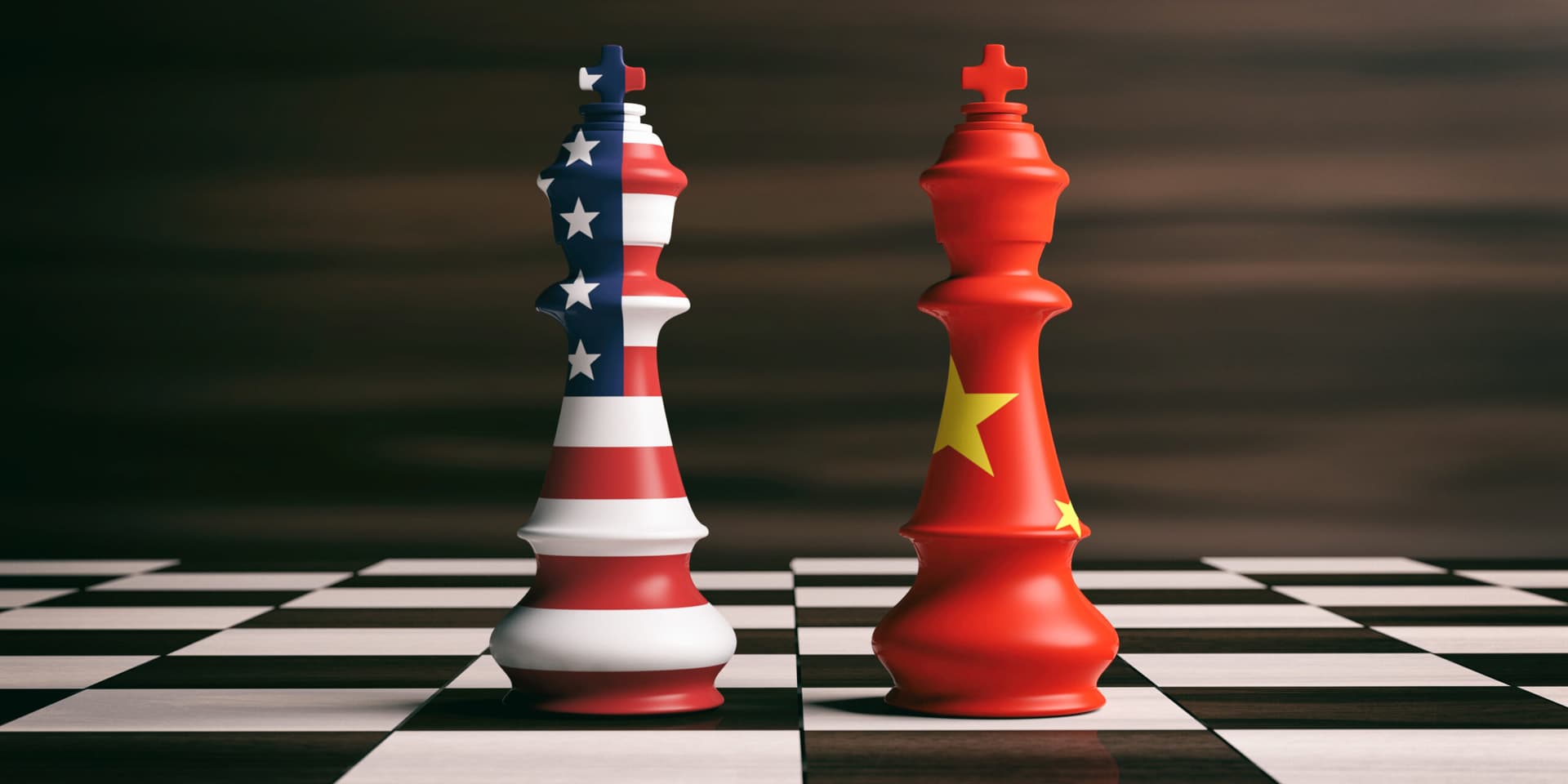
The trade war between the U.S. and China is less a clean contest of dominance than a hard contest over whose dependency hurts more.
Alas, there are many hours to go before the March 31 summit begins.
The assault on Iran may strengthen Trump’s hand in talks with Xi because China is exposed to energy and does not have many attractive response options.
If Trump can prosecute strikes on Iranian nodes while keeping the summit calendar intact, he arrives in Beijing having shown that Washington is still willing to use hard power while negotiating trade, chips and tariffs.
That does not guarantee Chinese concessions. It does alter the room. Smoke in the distance has a way of focusing attention at the bargaining table.
 The Global Risk Board As of This Morning
The useful facts are plain enough. Chinese refiners cut production. Wang Yi called for the attacks to stop. Beijing opened its annual parliament under slower growth and a heavier technology agenda.
Washington kept the summit track alive despite fighting alongside Israel in Iran. Oil still has to move. Chips still have to be made. Rare earths still have to be refined. The workshop, the fleet and the bargaining table are all part of the same story.
For investors, the question is not whether China became powerful. It did.
That chapter has already been written.
The live question is whether Beijing can keep funding military modernization, AI self-reliance and geopolitical reach while growth cools, property sours and energy costs rise.
The companion question is whether Trump can use Iran as leverage against Beijing without turning a strategic flank into a financial sinkhole. Those are the pressure points on the board this morning.
The U.S. dollar and Treasurys lie in the balance. Gold is, as has been historically true for millennia, the apolitical asset of choice.
~ Addison
P.S. Thank you if you joined us on Friday for a special Grey Swan Live! from inside the Rarcoa Vault in Chicago. The reserved Silver Eagle set we had reserved was quite popular, and just a few more remain.

Grey Swan Live! returns to its regular time this week, 2 p.m. ET on Thursday.
John Robb, author of Brave New War and Grey Swan Investment Fraternity contributor, joins us for a discussion on the war with Iran, how it’s being fought, and what it means for the dollar and other assets.

With market volatility on the rise and a new set of global challenges arising from this conflict, you won’t want to miss out on this week’s Grey Swan Live!
Robb’s expertise on network warfare is central to understanding the Trump strategy for disrupting operations by killing 40 top Iranian leaders. In a globally-connected tech economy in the 21st century, the strategies and weapons of warfare are evolving rapidly.