
GSI Banner
  • Free Access
  • Contributors
  • Membership Levels
  • Grey Swan Forecasts
  • Video
  • Origins
  • Sponsors
  • My Account
  • Sign In
  • Join Now

  • Free Access
  • Contributors
  • Membership Levels
  • Grey Swan Forecasts
  • Video
  • Origins
  • Sponsors
  • Contact

© 2026 Grey Swan Investment Fraternity

  • Cookie Policy
  • Privacy Policy
  • Terms & Conditions
  • Do Not Sell or Share My Personal Information
  • Whitelist Us
Ripple Effect

Inflation Pressure Is Baaaack

Addison WigginAddison Wiggin

April 15, 2026 • 1 minute, 44 second read


Consumer Price IndexFederal ReserveInflationTaxesTrump

Inflation Pressure Is Baaaack

Tax day. There’s no more pernicious tax than inflation in your own currency.

The stock market follows consumer price inflation (CPI) for its headline inflation. The Federal Reserve targets producer price inflation (PPI). 

Those measures often move in lockstep, but right now, producers are getting the squeeze:
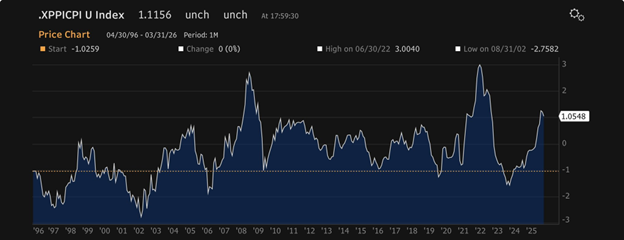
Core PPI less Core CPI is rising – a trend that has typically marked a resurgence in inflation that has preceded a market downturn. (Source: @yieldsearcher via X)

As Dr. Mark Skousen explained in our Grey Swan Live! conversation last Thursday, producers dealing with both inflation and tariff burden saw the broader measure of gross ouput (GO) go negative in fourth-quarter 2025.  

In past periods where core PPI has soared over CPI, producers have faced margin pressures. And when that happens, it tends to result in poor margins, earnings misses and a sell-off in the stock market.

The prior two spikes in PPI against CPI occurred in late 2021, going into the 2022 bear market. And in mid-2008, amid soaring oil prices ahead of the Great Financial Crisis.

The S&P 500 Index closed at a near-historic high again yesterday. Earnings season is about to kick off again. As an investor, pay attention to the impact of new inflation data on corporate balance sheets, especially the PPI.  

And… keep your eyes peeled for Shadow Stocks – volatile stocks that move rapidly up and down beneath the surface of the calm indexes. Earnings season is a ripe time for cherry-picking stocks. 

~ Addison

P.S.  Last week’s Grey Swan Live! with Dr. Mark Skousen yielded a romp through political and economic “liberty” from the signing of the Declaration of Independence and the 25o-year anniversary of Adam’s Smith’s Wealth of Nations – with a strong detour through the renaissance accomplishments of Benjamin Franklin – all the way to Elon Musk and the entrepreneurs leading the U.S. economy into the AI and space age.

You can watch the replay of Grey Swan Live! Mark Skousen in the members section of the Grey Swan website. If you’re not already a member, click here to join our latest livestream.



One Sign that Government Spending Is At a Crisis Point

August 7, 2026 • Addison Wiggin

Debts and deficits will eventually cause a crisis. Treasury Secretary Scott Bessent’s effort to help bail out the Japanese Yen this week is entirely motivated by self-preservation. The contagion signal flashing in Japanese bonds since late ‘25 is infecting the BOJ, which may be forced to sell U.S. Treasurys to stabilize its own currency.

One Sign that Government Spending Is At a Crisis Point
“Doc” Copper Tests Positive for Testosterone

August 6, 2026 • Addison Wiggin

The copper price is no doubt benefiting from inflation driven by money printing. But the doc don’t lie. Copper’s new all-time highs, while gold and silver still languish, are a sign the AI growth story is also that of the global economy itself.

“Doc” Copper Tests Positive for Testosterone
Gold Mining Stocks Still Big Winners Amid the Price Pause

August 5, 2026 • Addison Wiggin

Many miners were profitable with gold around $2,000 and silver near $50. At sustained prices closer to $4,000 gold and $60 silver, the arithmetic changes dramatically.

Gold Mining Stocks Still Big Winners Amid the Price Pause
The “Yentervention” Kicks US Markets Into High Gear

August 4, 2026 • Addison Wiggin

The stock market is getting an unexpected boost to kick off August, bucking the historically weak summer session for the U.S. stock market.

What’s happening? The Bank of Japan and the U.S. Treasury are making a coordinated effort to support Japanese yen; a move last attempted nearly 30 years in the height of the Asian Financial contagion (1998).

The “Yentervention” Kicks US Markets Into High Gear