

On the evening of October 18, 2025, we stood in line outside the Capital Turnaround in the D.C. Navy Yard — a plain brick building with no windows, the kind of exterior that doesn’t invite attention.
The crowd looked like it was waiting for a food pantry more than a futurist policy talk. Quiet. Tense. Earbuds in. People scrolling without reading.
We entered in small groups, passed metal detectors, checked bags and backpacks at the coatroom, then stepped into an old rail depot converted into an event space that functions as part museum, part nightclub.
A cash bar sat under loud 2000s alternative pop hits. Startup hoodies leaned against tailored suits. Defense contractors sipped cocktails next to people who looked like they build software for a living.
It was an odd scene.
And little did I know the events of that night would describe, accurately beyond my imagination, what would unfold five months later in the Persian Gulf.
🔫A “Gun Store” To The World?
Prophetic and bizarre, the program opened with a Jewish-Iranian comedian doing an audacious set about Gaza — still unresolved, still raw — stopping more than once to ask the room, “Too soon?” as people shifted in their seats.
Bari Weiss hosted the night as part of a series called The Future of American Power. The day before, she announced that The Free Press had been acquired by David Ellison’s Paramount Skydance and that she would help shape editorial policy at CBS News. People in the room cheered when she confirmed it.
Then Palmer Luckey walked onto the set in flip-flops, a Hawaiian shirt, a copper bomber jacket, a mullet and a soul patch — the man who sold Oculus to Mark Zuckerberg’s Meta Platforms (META) for $2 billion at 21, then got fired after contributing $9,000 to a pro-Trump super PAC billboard effort.
Luckey wasn’t there to litigate the past. He wanted to describe the present tense of war planning.
His China 2027 scenario drove every Anduril product line he described. Each a solution to the mass military-industrial-complex, which he described as “a blockade more than a blitzkrieg, logistics strangled, delay turned into defeat.”
And too damned expensive.
Luckey aggressively advocated that the U.S. stay out of foreign conflicts and become the “gun store to the world”: Build cheaper. Build faster. And get them into the hands of the people who need them.
Five months later, we can see he got most of his analysis of current events correct, except the part about steering clear of foreign entanglements, as George Washington warned 250 years ago.
⚖️ 🧭 A Profound Paradigm Shift
This morning, Anduril co-founder Trae Stephens was on Fox Business with Maria Bartiromo and said the United States is now prepared for mass drone production.
Stephens called it a “paradigm shift.”
The shift is more profound than he was giving it credit for. The new technology of war will shape the post-World War II geopolitical map in ways yet unknown. The rapid technology being deployed is only a glimpse of what an AI economy will look like in both a military and civilian context.
The opening salvos of the war have opened Pandora’s Box. We, collectively, watch with morbid fascination as the tech is deployed day by day.
While world markets try to sort out oil and energy prices, the last 25 days of war have forced a more basic repricing underfoot: the price of defense, the pace of procurement, the vulnerability of networks and the industrial capacity required to keep up.
War teaches us things about ourselves that we may not want to know. It teaches what we are willing to pay to preserve our prosperity. We learn quickly what we expect as normal when the alternative feels worse.
The impacts remain long after the headlines move on. That persistence is what we call history.
🛰️ Network Warfare Moves to the Balance Sheet
John Robb has argued for years that modern conflict migrates toward network warfare: attack the nodes, disrupt the flows, force the system to defend everything at once. The target list grows to include ports, pipelines, power grids, satellite constellations, cloud regions, clearinghouses and the insurance and financing structures that enable them.
Over the past 25 days, that logic scales through state budgets.
In Ukraine, the time from detection to strike has compressed from roughly 30minutes to a few as coordinates move from sensor to shooter through digital networks.
Hunter drones transmit data to a commercial satellite, which provides imaging of ports, pipelines, rail hubs and armored formations. “Synthetic aperture radar” sees through cloud cover and darkness. Cloud computing turns imagery into targeting data quickly enough to matter.
Then the killer drones swarm the target. It takes milliseconds.
Ukraine’s 10- to 15-kilometer “drone walls” create a no-go zone; death for humans. Iran’s IRGC, decentralized and still alive, fires Kamikaze drones at $10,000 $15,00o a pop.
The academics are trying to catch up. Stanford’s Cyber Policy Center calls the competitive advantage “knowledge power,” measured in research depth and technical talent. The World Economic Forum this year workshopped it as “an AI arms race” and tried to reconcile the brave new war with its climate emergency objectives.
For most normal people, it is, in fact, a brave new world.
Half the time, we watch the footage available in real time online and then channel our Millennial children: “This is cra-cra.”
The economics are hard to keep track of, too.
🧮 Punishing Math and the Treasury Screen
We did our best to understand the arithmetic of asymmetric war in this month’s issue of the Grey Swan Monthly Bulletin. Iran’s offensive toolkit, as you outlined in the Bulletin lead, relies on volume, cost efficiency, and decentralization.
A Shahed-136 can be assembled for roughly $20,000 to $50,000 using commercial components and a motorcycle-class engine.
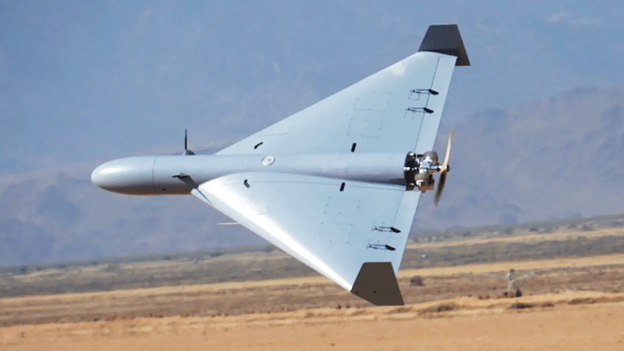 Iranian ballistic missiles cost roughly $1 million to $2 million each; Iranian “Kamikaze” drones can be manufacturing in real time during the conflict for $10,000-$15,000. The intercept costs remain higher on the U.S. side of the ledger. (Image source: TWZ)
A Tomahawk cruise missile runs about $2 million. A Patriot interceptor costs roughly $4 million. THAAD interceptors range from $12 million to $15 million. Naval systems such as the SM-3 can cost more than $25 million per shot. A $50,000 drone meets a $4 million interceptor and the exchange rate approaches 1 to 80.
Estimates place U.S. operational spending between $900 million and $1 billion per day, with more than $3.1 billion going toward replenishing munitions inventories in the first week alone.
The receipts print in real time: each intercept, each launch, each replenishment contract.
Meanwhile, as we pointed out in Shock and Awe, Redux, the United States national debt crossed $39 trillion last Thursday.
None of the $39 trillion yet accounts for an asymmetric war with Iran.
Since the opening strikes against Iran on February 28, 2026, the Treasury market has adjusted expectations. The 10-year yield pushed above 4%, raising financing costs on the existing debt stock before additional off-budget war spending arrives.
The Congressional Budget Office penciled in a roughly $1.9 trillion deficit for fiscal year 2026 before the shooting started.
New assumptions around war spending expanded by roughly $600 billion annually in the same timeframe, pushing the war budget toward $1.5 trillion.
Bond markets translate this into auction math and risk compensation. More issuance requires more buyers. Higher risk requires higher yield.
As we have said frequently, the “bond vigilantes” do not issue policy statements. But they do show the military what the limits of warfare are… economically speaking. If the war spins out of control like so many talking heads in the mainstream media are expecting… the vigilantes will come knockin’ soon enough.
🧭 From Bronze to Drones
Throughout history, military technology has moved the goalposts, changed the meaning of victory and emboldened political strategy. For now, it’s hard to pinpoint exactly what “drone swarms” will mean for the peace and prosperity of this spinning ball we call home.
When iron replaced bronze, weapons became cheap enough to arm entire populations, and war shifted from heroic combat to organized formations.
When gunpowder arrived, castles and knights gave way to centralized states that could finance standing armies.
The industrial era flipped the equation again, where railroads, machine guns and artillery made production capacity more decisive than maneuver.
World War II restored speed — tanks, aircraft and carriers rewarded coordination over mass — before nuclear weapons made direct conflict between great powers effectively unwinnable, shifting strategy toward deterrence.
The information age then compressed time itself.
Satellites, GPS and precision munitions meant the side that could see and decide faster could strike first and more accurately.
Now the equation is shifting again. Cheap drones and autonomous systems are driving down the cost of offense while pushing up the cost of defense. A $50,000 drone can force a multimillion-dollar response. Swarms overwhelm precision. Production speed matters more than platform perfection.
The pattern holds across every era. Technology changes the tools, but the winners are always the ones who reorganize around the new math first.
🧠 From Battlefield to Balance Sheet to Living Room
So too, military technology rarely stays on the battlefield. The internet began as ARPANET, a decentralized system to ensure communication in the event of a nuclear war.
GPS was built for missile guidance before it was used to tell you how to find the nearest Walmart.
Jet engines, radar, semiconductors and satellite communications all passed through defense budgets before appearing in commercial markets.
Drone navigation already guides delivery logistics. Computer vision built for targeting has been implemented in warehouses and automated factory assembly lines.
Cybersecurity built for grid defense had enterprise-level software. Satellite imaging is used for insurance underwriting and commodity tracking.
Even finance follows the same path. Stablecoins and real-time settlement rails mirror the need for resilient, always-on systems that don’t fail under stress.
What begins as a military requirement becomes a commercial advantage. As investors, we’re sitting in the front row of that spectacle, too.
🌴 Miami and Sovereign Capital Formation
The Future Investment Initiative’s Priority Summit takes place from March 25 to March 27 at the Faena Forum in Miami Beach under the theme “Capital in Motion.” President Donald Trump is scheduled to deliver a keynote address on March 27.
The Saudi delegation includes Yasir Al-Rumayyan of the nearly $1 trillion Public Investment Fund, Finance Minister Mohammed Al-Jadaan, Tourism Minister Ahmed Al-Khateeb, and Ambassador Princess Reema bint Bandar. Speakers include Jared Kushner, Steve Witkoff, and Ken Griffin. Human Rights Watch plans a press conference in Miami Beach on Thursday.
Saudi Arabia has pledged up to $1 trillion in U.S. investments across critical minerals, defense, nuclear power, and technology.
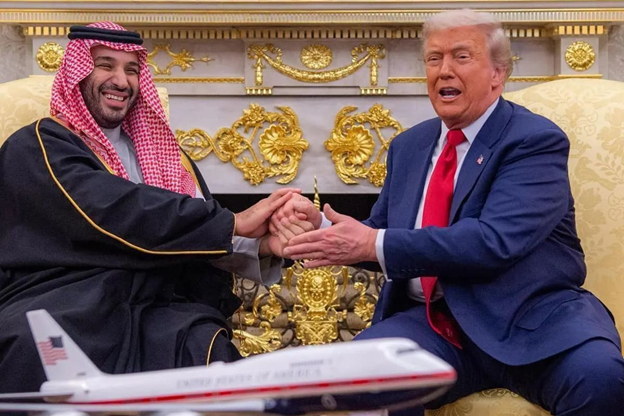
Saudi Prince Mohammed bin Salman (MBS) and U.S. President Donald Trump shake hands, memorializing a grand bargain struck on November 18, 2025. (Source: Economy Middle East)
Who knows what President Trump will actually say when he addresses the conference as the keynote speaker on Friday night in Miami.
Even his closest aides don’t have a clue.
But we have our guesses based on our grand bargain thesis and have placed a few bets accordingly. See: New Signal from Patented “Grey Swan Alert” AI Software.
🪙 Dollar 2.0, Retail Flows, and Financial Nodes
Heads up: Our dollar 2.0 plays have been getting whacked again in trading today on rumors that the latest draft of the Clarity Act rejects rewards for stablecoin owners.
Coinbase CEO Brian Armstrong said retail users were “buying the dip” and that he remained “more bullish than ever,” according to Yahoo Finance. He points to subscription and institutional services beyond trading fees. He wrote on X that retail balances in bitcoin and Ethereum remained steady or increased during volatility.
If you’ve attended any of Grey Swan Live! episodes in 2026, you know how we feel about the banking lobby and what they’re trying to do to the “crypto space”. [Spoiler alert: we’re not happy about it. And apologize again for dropping f’ bombs in public]
🌊 History Also Changes Perception
On March 24, 1989, the Exxon Valdez ran aground in Prince William Sound and spilled an estimated 11 million gallons of oil. Wind and currents carried the spill more than 100 miles and contaminated over 700 miles of coastline.
Captain Joseph Hazelwood was convicted of misdemeanor negligence in March 1990, fined $50,000, and ordered to complete 1,000 hours of community service before an Alaska court overturned the conviction in July 1992 under a federal reporting statute.
Exxon initially agreed to pay $100 million and provide $1 billion over 10years for cleanup; in October 1991, it settled for $25 million.
The view of ducks sopped and floundering in oil has forever changed the way the voting public sees oil as an energy source.
For over 40 years, Dawn has used this imagery to highlight its effectiveness in cutting through grease, specifically showcasing its use by wildlife rescue teams to clean oil-covered ducks and other marine animals.
Ironically, most conventional dish detergents, including Dawn, are derived from petroleum.
So it goes.
~ Addison
P.S. This week on Grey Swan Live!, we’re coming to you from Panama City — on the ground with Ronan McMahon — to explore an investment opportunity most people overlook entirely.
International real estate. Not as a theory… But as something you can actually use, enjoy, and profit from at the same time.

And if you missed last week with Shad Marquitz, take a minute to watch the replay now.
In the middle of a chaotic market — war headlines, energy spikes, metals selling off — Shad did what he does best: He mapped the terrain … and named names.
Shad walked us through more than 22 specific tickers. Check it out.