It’s summertime and the livin’s easy.
The days are long, the rosé is chilled, and the markets are feeling downright beachy. As we close out the first half of 2025, the S&P 500 is lounging at an all-time high, investors are basking in trade optimism, and the Fear Index has tumbled into a hammock.
But the witches’ brew of economic data we reviewed on Friday has us uneasy. While the indexes are soaring, the economy’s vital signs still look pale and a little shaky.
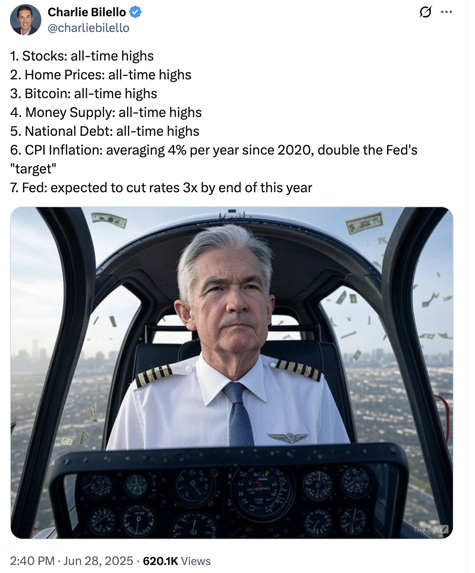
Something’s gotta give.
The S&P 500 closed at a fresh all-time high Friday, capping off a stunning rebound from the post-Liberation Day nosedive in April.
That’s a near 20% drop followed by a full recovery in under two months — a trick pulled off only five other times since 1950.
Each time, the following 12 months saw average gains of over 30%. Of course, past performance is no guarantee of future success, except for cocktail party trivia.
As we head into the holiday week, the end of the first half of the year, and the beginning of Q3, it’s worth taking stock… a look-see at where we’ve been.
 Liberation Day’s Hangover
What President Trump dubbed “Liberation Day” was supposed to mark the beginning of a Great Reset. Instead, it nearly reset the S&P 500 to pandemic-era lows.
The tariff poster board — a prop now seared into investor nightmares — unleashed chaos. Nearly $2 trillion in market value evaporated by the opening bell.
Over 80% of S&P 500 companies were down, most of them by more than 2%. Apple, Amazon, Meta — all tanked. Retailers, dependent on cheap imports, bled red. Only consumer staples and utilities offered a shred of green refuge.
Meanwhile, Treasury yields, which normally offer a safe haven, surged in defiance. The 10-year yield broke 4.5%, its biggest three-day jump since 2001. The 30-year posted its largest gain since 1982. Traders dumped bonds alongside equities — not out of fear of inflation, but fear that Washington had lost the plot.
The lifeline came a few days later. A strong $39 billion 10-year auction gave the bond market a jolt of confidence. Within the hour, Trump blinked — announcing a 90-day tariff pause. Wedbush’s Dan Ives said the quiet part out loud: “The eye-popping rise in yields forced Trump’s hand.”
Trump’s Exec Order #14154 —
A “Millionaire-Maker”
Donald Trump has cheated death.
He’s overcome insane and criminal vote rigging.
And survived every indictment and impeachment thrown at him.
But his next move could make him a legend – and perhaps the most popular president in U.S. History.
Former Presidential Advisor, Jim Rickards says, “Trump is on the verge of accomplishing something no President has ever done before.”
And if he’s successful, it could kick off one of the greatest wealth booms in history.
We recently sat down with Rickards to capture all the key details on tape.
For the moment, you can watch this interview free of charge – just click here.
 The Great Reset, It’s Early Aftermath
President Trump spent Friday telling reporters he wants to see interest rates at 1%. Not 4.34%, where they sit now. One percent.
Apparently, according to his remarks, he’s nostalgic for the zero-interest rate policy (ZIRP) policy Janet Yellen foisted on the markets for the years preceding Jerome Powell’s current regime.
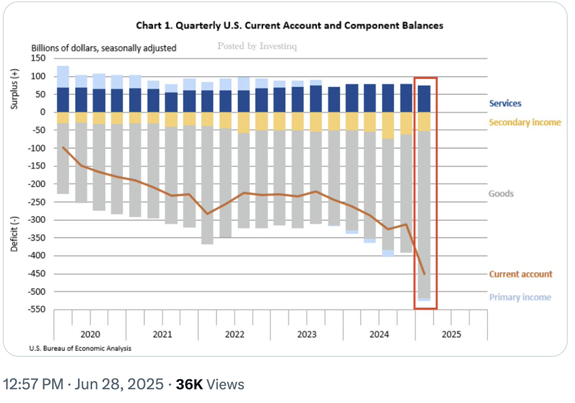
As the Senate tortures the House’s efforts to cut spending along with taxes this week, the deficit hits historic highs. (Source: U.S. BEA)
With zero regard for moral hazard, ballooning deficits, or what happens when the wealth gap turns from troubling to torch-wielding.
As if to underscore the point, Jeff Bezos and Lauren Sánchez’s $55 million wedding in Venice reportedly injected $1.1 billion into the Italian economy. That’s one couple’s honeymoon… versus the GDP of a small country.
Populism may be pushing its weight in the White House and on the floor of the House… but plutocracy is still throwing the party.
 PCE Inflation: Still Hot, Still Sticky
The Fed’s preferred inflation gauge offered Powell little relief from Trump’s abusive comments or Truth Social posts. Headline Personal Consumption Expenditure (PCE) rose 0.1% in May, with the annual rate at 2.3%.
Core inflation is running hotter, at 2.7% year-over-year.
Meanwhile, consumer spending fell 0.1%, and personal income dropped 0.4%, a miss that economists had hoped would be a gain. It’s a “recovery” that looks better on paper and the headlines than it feels at checkout.
 The Recovery That Wasn’t
Since April, the S&P 500 has staged a tech-led comeback, with Nvidia and Palantir carrying the torch. But it’s a rally with a hollow core. Small caps are still in the basement.
Health care and consumer discretionary can’t catch a bid. We even warned that was the case with some of our research earlier this year, with one report outlining 50 stocks to avoid as President Trump’s tariff war played out – with UnitedHealthcare shares sliding nearly 50% in a week amid that company’s specific turmoil.
The broader market isn’t recovering — it’s just being carried by seven tech titans whose earnings remain fueled by speculation and algorithmic sugar.
Even consumer sentiment is split.
The Conference Board’s index fell to 93, while another index showed improvement. One says people are feeling worse. The other says they expect inflation to be slightly less awful.
Either way, it’s hard to reconcile the data with the champagne popping on Wall Street.
 The Illusion of Strength
A jam-packed holiday week lies ahead. Tuesday brings JOLTS and manufacturing data. Wednesday offers ADP’s employment report. Thursday is the big one — jobless claims, services PMI, and June’s nonfarm payrolls report. The Fed’s July 30 rate decision looms, and markets are betting on one or two cuts. Trump’s betting on three.
The VIX has dropped below 17, signaling calm. But the calm feels like the stillness before the second half kicks off and someone forgets which basket they’re shooting at. We’re entering Q3 with markets at highs, AI at the helm, and the economy muttering, “I’m fine” while lying on the couch in sweats.
So take a beat. Celebrate the 4th. The sun is shining, the rosé is crisp, and the indexes are up. But remember: real growth happens when the music stops and you’re still on your feet.
~ Addison
 P.S: Grey Swan Live! on Thursday, July 3 at 11 a.m., Andrew and I will take stock of the first half of the year. We’ll do a comprehensive review of the model portfolio and review the big trends that have impacted stock prices and the economy during the dizzying first months of the second Trump administration. Stay tuned… it promises to be a doozy.
Your thoughts? Please send them here: addison@greyswanfraternity.com