Beneath the Surface
Don’t Let Dilution Cost You Profits In Today’s Gold Rally

July 14, 2025 • 5 minute, 24 second read
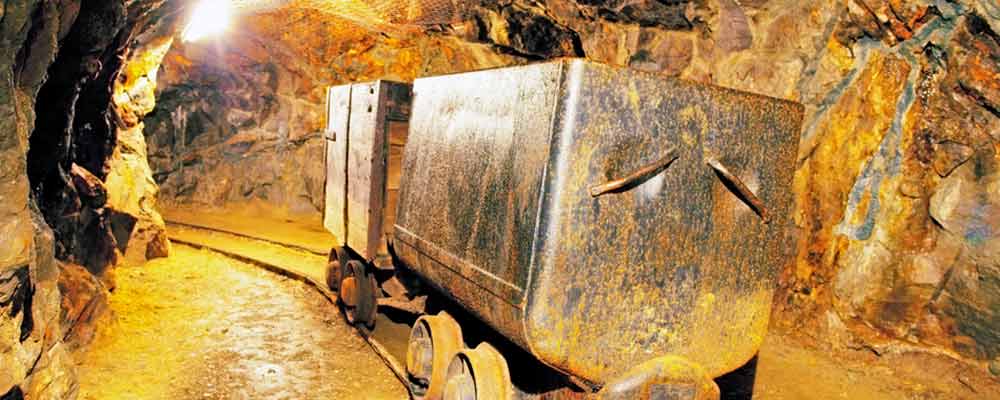
“A gold mine is a hole in the ground with a liar on top.”
— Attributed to Mark Twain
July 14, 2025 — One of the first individual stocks I ever bought was a gold miner.
The year was 2002. Gold prices had been trending higher since bottoming in 1999. But this was really the first year that it felt like a bull market underway.
Right place, right time. And the company I bought, Richmont Mines, took off with gold. By the time I sold out, I had a triple on my hand – and was off finding other opportunities in the resource space with similar setups.
Most gold mining companies will fare well in a bull market. That’s because the price of gold tends to rise faster than the costs of mining. So if gold prices rise by $1,000 per ounce, a miner’s profit may rise by the full $1,000 per ounce.
The same is also true for other resources, whether oil, natural gas, or even copper, uranium, and rare-earths.
But there are other factors at play today. And those factors may be harming some of the gold positions in your portfolio, particularly some of the large-cap plays.
For instance, one of the largest players in metals today is Barrick Gold (GOLD).
With a market cap of about $37 billion, this industry giant is a pipsqueak next to tech stocks. But it’s a good stock to use as a comparison for performance with smaller gold mining companies.
In fact, it’s a model of what not to do.
Continued Below…
September 9: Denmark’s Last Gasp…
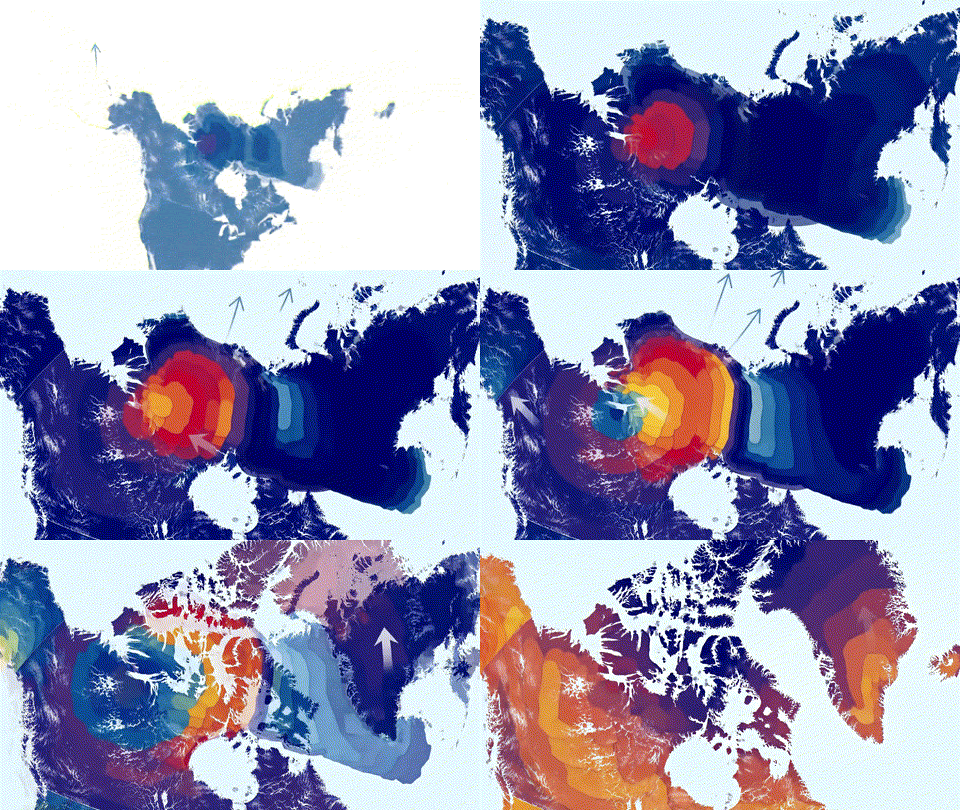
The Arctic’s vast abundance of riches — shipping lanes, resources, and space ports — makes it an economic and geopolitical Holy Grail, which is why Denmark’s stewardship of Greenland must end.
Greenland needs real protection. American protection.
Investors, take notice…
As the United Nations General Assembly approaches (on September 9), the potential exists for a bombshell announcement regarding Greenland. We mapped Greenland’s five major profit zones, which could boom any minute.
The Barrick Model: Diluting Away Gold Profits
Because Barrick Gold is one of the big players, or “majors,” as they’re known, they are on the lookout to increase their reserves. That means finding promising mining projects to acquire.
For companies that get acquired, it usually means a good premium for shareholders.
But the real question is, how does a mining company pay for new reserves?
For Barrick, it’s been pretty clear:
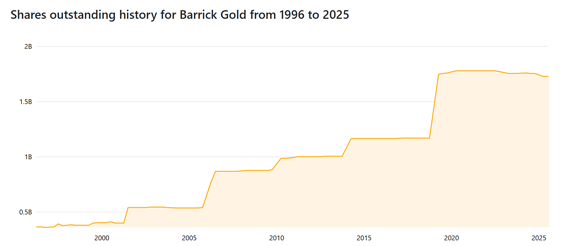
Since the start of this century, as gold has been an outstanding asset, Barrick has more than tripled its share count.
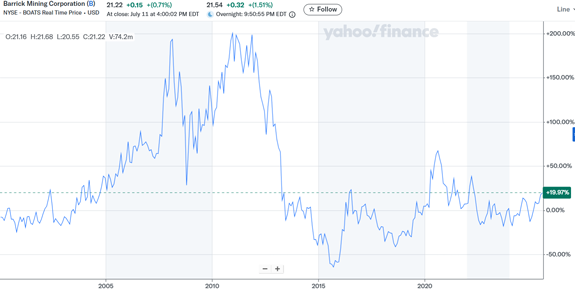
But since the start of 2000, Barrick investors are up about 20%. That’s less than 1% per year. And far less than the performance of gold, which is up nearly tenfold.
Yes, Barrick’s market cap has tripled this century. But that’s because its shares outstanding have tripled.
Existing shareholders got just a fraction of what they could have earned thanks to this massive dilution.
Unfortunately, Barrick isn’t alone. Other majors, such as Newmont Mining (NEM), have done the same thing.
This level of dilution goes against the reason to invest in gold miners in the first place: to outperform gold.
Light or No Dilution: The Key to Bigger Returns
One outlier among the major producers today? Check out Agnico Eagle Mines (AEM).
Agnico has also increased its shares outstanding, as with Barrick and Newmont. However, it’s averaged about a 1% increase annually going back the past 10 years.
And more importantly, Agnico has worked to ensure that it increases its total gold reserves per share, a key metric for investors today.
The result? AEM is up 65% in the past year, 80% in the past five years, and the company is one of the largest industry players with more upside potential as gold trends higher.
That’s why looking at your gold stock holdings with an eye to how much share dilution they’ve done is critical to your investment success.
Share dilution is real across any industry. But how shares are being diluted, and what they’re being diluted for matter.
In the resource space, that means paying close attention to the value of any announced acquisitions, the total shares outstanding, and how that company is performing relative to its underlying resource.
That can make the difference between a good investment, a middling investment, and a killer investment.
If you’re in a Barrick or Newmont, it may be time to move to an Agnico Eagle or similar shareholder-focused company.
I’ll admit – after reviewing the latest dilution data from these majors last week, I shifted some shares of Newmont I was still holding to another gold player ahead. I’m feeling much better about gold’s ongoing rally now that I’m not being held back by dilution.
Andrew Packer
Grey Swan Investment FraternityP.S. Gold itself is effectively diluted 2-3% annually thanks to gold mining companies. But its price is still on track to rise substantially higher as it lags global fiat money creation and central banks continue to buy hand over fist.
Our gold research suggests the metal can get into the five-figure range by the end of the decade. Possibly even sooner. And if we get into that stage of a gold rally, gold mining companies with little or no dilution are going to see some fantastic returns.
Meanwhile, reader Joan writes in:
I keep writing to you guys telling you how much I like what you are doing, and I keep getting hit by that truth over and over..
I don’t watch the news which has been a purposeful choice for lots of years. I get most of my news through reading the financial gurus that I follow.
I am so so glad that I am on the gray Swan ship. Just the fact that you present the news, and then sometimes say you don’t really know what all that means and what we should do speaks volumes. I really don’t want to go down the wrong roads right now just because someone has hyped it into sounding like a great place to go!
Thanks, Joan! We can’t do what we do without our readers.
As Bill Bonner likes to point out, we’re ALTERNATIVE media, and that means we can be focused on the truth – or when we plainly don’t know something – rather than speak with false authority.
Your thoughts? Please send them here: addison@
greyswanfraternity.com