Swan Dive
A Commodity Supercycle Is Underway as Investors Seek the Truth

July 14, 2025 • 6 minute, 22 second read
Last week at the Rule Investment Symposium, I met with senior leadership from dozens of natural resource companies in their early stages.
One common theme was apparent: Commodities are back in a bull market.
Just take a look at how commodities have fared over the past 15 years:
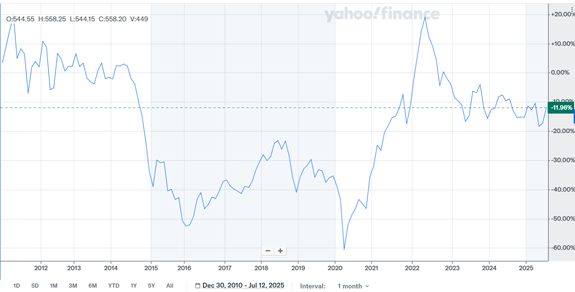
After quickly rebounding from the Global Financial Crisis, prices declined, reflecting the slow economic recovery. The Covid crash, however, marked a turning point.
Policymakers flooded the system with so much money that it kicked off a new bull market in commodities. Unlike the stock market, such trends can last for decades. And the big, life-changing moves often occur in the second half of that trend.
Commodities have pulled back a bit from their 2022 highs, coinciding with rising interest rates and as Russia’s invasion of Ukraine failed to keep oil prices from staying high after an initial spike.
 A Changing World
The critical story from the above chart is what didn’t happen…
After OPEC+ nations started pumping out as much oil as possible in late 2014, there was an underinvestment in new oil exploration projects, a trend that’s now lasted for a decade.
Gold, which peaked in 2011 and declined for five years straight, saw a similar pullback in investment capital.
Great projects still came along. But the big finds in gold and oil from decades past – the proverbial gushers – aren’t being found today.
Today’s new resource companies can’t close the gap, but they can bring new resources to the economy as prices stay high, and make early investors big money. And that makes exploration companies their most attractive in decades.
 The AI Pivot
Today, demand for commodities is rising, particularly key elements needed to sustain the AI boom. That means nuclear energy, backed by uranium. And oil and gas to power smaller projects.
But it also means silver, a key industrial metal, along with copper. Both are often found in veins that are riddled with gold.
In short, today’s AI pivot isn’t just about creating the latest mind-bending software and tools to increase productivity. It’s a reminder that we can do those things because we have an abundance of natural resources.
But with the underinvestment we’ve had over the past decade, prices still need to rise to meet demand.
Not to mention, as long as governments deal with the after-effects of the Pandemic-era stimulus, gold has strong investment demand, particularly from central banks.
But it’s not just about a resurgence of inflation. It’s a reflection that nation states in the post-Pandemic era are more insular and less globalist.
On one level, that can mean increasing isolationism. Tariffs and other forms of protectionism are just one aspect of that trend. But on the other hand, international payments are now in the crosshairs of isolationism.
For instance, Russia’s invasion of Ukraine didn’t lead to a lasting move higher in oil prices. Instead, Russia was ejected from the global financial system, notably the SWIFT payment network.
Central bankers took note, that their countries could be next. That’s why countries like Russia, China, and Turkey have led the way in central bank buys.
It’s that declining trust in other nations that has caused gold demand to surge. And why it’s likely to continue for the foreseeable future.
But declining trust isn’t just a monetary trend…
Out of 23,281 Stocks… Only ONE
is This Profitable and Undervalued.

$3 billion+ in operating income. Market cap under $8 billion. 15% revenue growth. 20% dividend growth.
No other American stock but ONE can meet these criteria… here’s why Donald Trump publicly backed it on Truth Social.
 Missing Tape… Again?!
Team Red, as Grey Swan Contributor John Robb calls it, is fracturing.
As Robb notes in our July issue for paid members – paid-up members will get an email when the issue is posted to the site later today – President Trump’s bombing campaign in Iran involved a heavy calculation of potential lost support from members of the MAGA movement who want to keep America out of foreign wars.
Most of the attacks against Trump have come from Team Blue. That includes the Russiagate hoax in his first term, the impeachments, and his legal woes during his four years out of office.
Now, however, the real threat to Trump comes from Team Red. Specifically, those who want to see disclosure of past government wrongs, especially the Epstein client list.
Attorney General Pam Bondi can’t seem to find the list, despite claiming weeks ago that it was on her desk.
Yes, we know there’s a list. Yes, we know that many well-known figures across the political aisle are on it. And that it will alter our perception of many.
But to deny its existence, and then send out a video with metadata showing it had been doctored?
The missing minute of the Epstein cell video is reminiscent of the 17-minute gap in the Watergate tapes.
While we live in a system where people are innocent until proven guilty, missing evidence, whether deliberate or not, creates an immediate sense of guilt. Something is being hidden. Deliberately.
In short, what we’ve heard over the weekend doesn’t pass the smell test.
It’s easy to see why some on Team Red are turning against President Trump. The disclosure of the Epstein list is being thrown into the memory hole as quickly as promises to declassify all JFK files and to audit Fort Knox.
Coming on top of the Big, Beautiful Bill’s lack of financial conservatism, and Trump’s Iran bombing, we wouldn’t be surprised if critical members of Team Red sat out the 2026 midterms.
In the fight to drain the swamp, hiding the Epstein list is a big victory for the swamp. And as many Americans felt about Watergate, the coverup is just as bad – if not worse – than the crime.
Ultimately, the longer it takes for it to get out – if at all – the more trust will erode against all our institutions, whether you’re on Team Red, Team Blue, or simply Team Truth.
Trust in our institutions is already in short supply – and our Grey Swan prediction for 2025 of rising political violence may yet play out.
 Truthful Capital Will Keep You Free
Truth matters.
Free and fair money, whether measured in gold ounces or satoshis – a one-hundred-millionth of a bitcoin – can compel a governmental and political system to stay honest. Or at least within some rails.
Fiat currencies, which are determined by those same governments, provide unchecked power, including the ability to keep some in power despite clear abuses of it.
History shows time and again that it’s the power to destroy.
Public confidence has been hit with a one-two punch of hefty inflation the past few years, and a sense of a two-tiered justice system that projects those in power who were harming children.
In a time of rapidly-declining trust in traditional institutions, it’s more important than ever to make sure you hold gold and bitcoin.
I know I sound like a broken record – but every day, there’s about 3 billion more reasons to hold those assets. And that’s just the daily increase in America’s federal debt.
~ Andrew
P.S. Addison is enjoying some downtime with family this week, but I’m looking forward to providing more insights into the resource space as I write up my notes and thoughts from the Rule Investment Symposium.
And I’ll have a heads up for members on plans for this week’s Grey Swan Live! as they’re finalized.
Stay tuned!
Your thoughts? Please send them here: addison@greyswanfraternity.com