
Yesterday, Argentina’s new president Javier Milei became the first foreign leader to meet with president-elect Donald Trump at a gala at Mar-a-Lago.
The mutual admiration makes perfect sense.
Both Milei and Trump have emerged from countries grappling with serious systemic issues. While Argentina’s problems may be on a whole different level, both the U.S. and Argentina face common challenges—runaway cost of living, crippling debt, an ever-expanding federal bureaucracy, and what Elon Musk calls the “woke virus” that has turned institutions from universities to government agencies into bastions of progressive ideology. And just like Milei, Trump has been relentlessly attacked by the mainstream media, painted as a dangerous radical—even a Nazi.
Two Leaders, One Promise
Another thing they share is their promise of something you almost never see in politics: actually cutting government bloat and inefficiency.
Well, Javier Milei didn’t just promise—he delivered. Armed with his symbolic chainsaw at campaign rallies, he turned metaphor into action on his first day in office.

He abolished half of Argentina’s federal ministries, laid off 50,000 state workers, devalued the currency by 50%, halted public works, and slashed subsidies. His “zero tolerance” approach to deficit spending has already shown results: monthly inflation has just plummeted from 25.5% to 2.7%. That’s the lowest level in three years.
Now Trump appears ready to follow suit. I wrote recently about him floating the idea of Elon Musk leading a new initiative called the Department of Government Efficiency (DOGE)—a nod to Dogecoin, the cryptocurrency Musk has famously backed.
Just earlier this week, on November 12, it became official. In his announcement naming Musk and Vivek Ramaswamy as DOGE’s co-leaders, Trump wrote that it “will become, potentially, ‘The Manhattan Project’ of our time.”
According to Trump, Musk and Ramaswamy “will pave the way for my Administration to dismantle Government Bureaucracy, slash excess regulations, cut wasteful expenditures, and restructure Federal Agencies.”
Music to my ears.
Musk, for his part, seems to get exactly what’s going on. From his X:
The excess government spending is what causes inflation. ALL government spending is taxation. This is a very important concept to appreciate. It is either direct taxation, like income tax, or indirect via inflation, due to increasing the money supply.
If you were at Trump’s Madison Square Garden rally, you would have also heard Musk declare:
Your money is being wasted and the Department of Government Efficiency is going to fix that. We’re going to get the government off your back and out of your pocketbook
The billionaire founder of Tesla and SpaceX is also uniquely qualified for the job—having recently cleaned house at both X and Tesla—and doesn’t mind ruffling feathers along the way.
Ramaswamy’s not holding back either. “We will not go gently,” he posted on X in response to the news, tagging Musk.
No surprise really—the biotech entrepreneur’s own presidential run earlier this year practically mirrored Trump’s platform. His vocal support even landed him on the VP shortlist, according to reports.
I remember him on the campaign trail in early 2024, promising to shut down everything from the FBI to the Department of Education (DOE) and the Food and Nutrition Service (FNS).
Once again, exactly what I want to hear. And at Mar-a-Lago, he doubled down on this determination in front of the crowd. “We’re not bringing a chisel. We’re bringing a chainsaw,” Ramaswamy told the cheering audience.
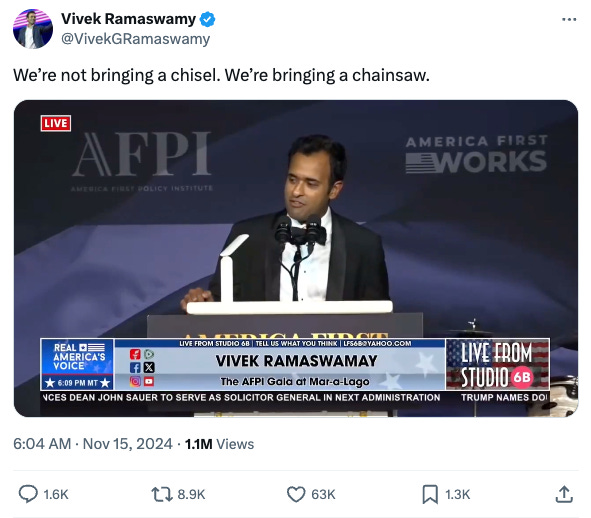
The chainsaw reference was no coincidental, of course—a direct nod to Milei’s signature style.
Daring to Believe
This is all great stuff—and I’m a fan of the chainsaw approach, which has worked wonders in Argentina. But now that the Mar-a-Lago celebration is over, I can’t help but wonder: can it really work in the good ol’ USA?
Well, I’ve been skeptical about Musk’s $2 trillion savings plan from the start— that’s almost twice what Defense ($900 billion) and Homeland Security ($103 billion) spend combined—and I haven’t changed my mind. The reality of government reform is simple but brutal: every “inefficiency” is someone’s livelihood, every “waste” is someone’s program, and every dollar of deficit is someone’s payoff.
This means that DOGE’s battle isn’t “inefficiency” in the sense the two entrepreneurs are used to—it’s with entrenched interests. The federal government isn’t Twitter or Tesla; you can’t just walk in and start firing people (unfortunately). Every department has its defenders in Congress, every program its vocal advocates, and every dollar of spending has a constituency that will fight tooth and nail to keep it.
And remember—unlike Milei, Trump won by a slim margin—just two percentage points. If that tells us anything, it’s that America isn’t quite as desperate for radical change as Argentina was. Many of his voters receive federal benefits, and they might not appreciate seeing their programs labeled as “waste.” The same goes for government employees facing potential layoffs, or industries benefiting from federal subsidies. Sure, Milei got away with all this—but again, only because Argentina was desperate in a way America just isn’t right now.
Beyond all that, there’s another thing bugging me—putting two highly ambitious men in charge of the same initiative. Musk and Ramaswamy are both used to being the loudest voice in the room—how will they handle sharing that megaphone? And where’s exactly the “efficiency” in that?
Maybe this is part of some bigger plan—a way out if Musk decides this is too much work and too little fun, and goes back to playing with rockets and trolling people on X. I’m no insider, but this just seems strange…
All that said, I’m feeling cautiously optimistic about all this.
Yes, the odds of this cleanup actually happening aren’t great. Whether you look at the government’s track record or Trump’s history from his first term, there are plenty of reasons to be skeptical.
Note: To those celebrating the Republican sweep of Congress, it’s important to keep in mind that the GOP was already in charge of both the House and Senate for the first half of Trump’s term, from 2017 to 2019. Even with that political control and and all the big promises, they still didn’t manage to deliver on substantial government downsizing during that time.
But here’s the thing—they are actually better than they’ve been in a long time. And sometimes, that’s all the opening reform needs. I mean, nobody thought a chainsaw-wielding economist could pull off what Milei’s done in Argentina, right?
Plus, Trump’s already pledged to take definitive action, like closing down the DOE. That agency has been an absolute train wreck—ever since it was established in ’79, America has gone from being a global leader in math and science rankings to ranking a dismal 24th and 38th. Definitely time to put that thing out of its misery.
In the end, though, the real question isn’t whether Musk, Ramaswamy, and Trump can make good on their promises—it’s whether we’ll get another shot if they don’t. Windows for radical reform simply don’t stay open forever. For those in favor of limited government and against bureaucratic bloat, this might be our best chance at meaningful reform for a generation. So we have to take it seriously. I certainly hope the team Trump do too, because if this falls through, the pendulum will swing to the left in the next election. And it will swing hard.
~~ Lau Vegys, Doug Casey’s Crisis Investing