
Investors ultimately benefit when management remembers a simple fact: shareholders own the business.
The most reliable way to build shareholder wealth is, of course, to own companies that consistently grow profits, allocate capital intelligently and treat shareholders like partners rather than an afterthought.
When those profits start piling up, investors should expect to participate in the rewards.
Traditionally, that comes through dividends. We covered those yesterday. While dividend yields remain relatively low today, that’s largely because much of the market’s value is concentrated in fast-growing companies that prefer to reinvest cash rather than distribute it.
But dividends aren’t the only way investors can be rewarded.
Share buybacks can be even more powerful.
When a company repurchases its own stock, the number of shares outstanding shrinks. Your ownership stake increases without requiring you to buy any additional shares.
Assuming profits remain steady or continue growing, earnings are spread across fewer shares, boosting earnings per share and often supporting higher long-term stock prices.
Think of it this way: every buyback increases your claim on the business. Your slice of the pie gets larger.
There’s another advantage. Unlike dividends, which trigger an immediate tax bill for many investors, buybacks allow shareholder value to compound without creating a taxable event. That’s one reason many successful companies have favored repurchases over cash dividends during the last decade.
But investors should pay attention when that trend reverses.
The “Magnificent Seven” technology giants that spent years aggressively buying back stock are now doing the opposite. Faced with enormous capital requirements for AI infrastructure, some are issuing shares and raising fresh capital.
Most notably, Alphabet (GOOGL) recently announced an $80 billion capital raise, through private placements, underwritten offerings and shares sold through an at-the-market (ATM) program:
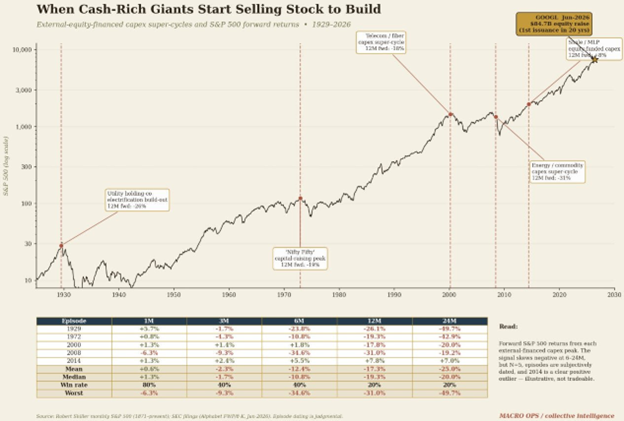
When market leaders start aggressively selling shares to raise capital for new projects, it’s often closer to a market top. (Source: Macro Ops)
History suggests this trend is worth watching.
When market leaders begin selling stock to fund ambitious expansion projects, it often signals that optimism is running high and capital is abundant — conditions that emerge only in the late-stage bull markets.
During the dot-com boom, telecommunications companies raised enormous sums to build fiber-optic networks. The infrastructure was eventually needed, but investor enthusiasm peaked long before the projects paid off.
In the 1960s, many of the celebrated Nifty Fifty companies tapped investors for growth capital shortly before the inflationary shocks of the 1970s arrived.
In the 1920s, utility companies raised vast amounts of capital to fund electrification after soaring stock prices gave them easy access to investors’ money.
The pattern isn’t limited to broad market manias.
Energy companies dramatically expanded spending during the tech-driven shale oil boom of the early 2010s, just before oil prices collapsed following OPEC’s production surge in 2014.
For the individual investor, like you, the takeaway is straightforward.
If the company you own reduces shares year after year through buybacks or simply by avoiding splits or issuing new shares, your shareholder value will increase. A shrinking share base means each remaining shareholder owns a larger piece of the pie.
The opposite is also true. In this case, as Big Tech races to be the leader in AI, each stock offering will dilute your share of the company.
Market-wide, that could shift investor enthusiasm for the very same shares that have dragged the indexes higher in the first place.
The bull market isn’t over. Yet.
But without massive buyback programs absorbing shares and supporting prices, markets become more vulnerable to disappointment, volatility and correction. Alphabet’s decision to sell shares should tell us something about the AI race at the top of the market. And give us reason to be wary, the crack-up boom is nearing its final blow-off.
Ironically, it’s another anecdotal piece of evidence the new Fed Chair Kevin Warsh could use to persuade the FOMC committee that now is the right time to cut rates and lower the costs of financing for the AI buildout. But we’ll take the new Fed regime up in another email.
Fortunately, there are plenty of non-tech companies that have been aggressively buying back shares and rewarding investors in recent years. You’ll find our top buyback play in Grey Swan Pro — details here.
~ Andrew
P.S. This week on Grey Swan Live!, we’ve got our eyes on the SpaceX IPO… just like everyone else. Be wary if you don’t already have a position. The critical question is. What happens to the market after SpaceX?
The SpaceX IPO will be the largest in history. It’s so big that rules for shareholders to cash out had to be altered to accommodate new capital and protect the rest of the market.
To understand what’s really going on – and what it means for markets – we’ll bring in a friend of Grey Swan, Adam O’Dell. Adam leads the Money & Markets research group, and his system-driven approach to investing has taken a lot of the guesswork out of investing.
Adam just released his latest research into what the SpaceX IPO means for markets, and how investors can best position themselves not just for the IPO – but whatever happens in markets next.
Please note the special time change this week – 1 p.m. instead of 2 p.m. See you there!
If you have any questions for us, send them to Feedback@GreySwanFraternity.com.