Ripple Effect
Market Reaches Its Lowest Dividends Since Dot-Com Bust

June 8, 2026 • 3 minute, 15 second read

The U.S. stock market suffered its worst week in over a year, snapping what had been an historic nine-week winning streak. The Nasdaq plunged nearly 5% on Friday, its largest single-day decline since April 2 to April 4, 2025, the aftermath of “Liberation Day.”
Last Thursday, the day before the crash, we warned here in Ripple: “Throughout history, stocks making parabolic moves higher, from tulips to tech stocks, often crash in equally spectacular fashion.”
Sure enough, the AI trade giveth, but it also taketh away. We can expect more of these wild swings as the crack-up boom thunders along.
Even with Friday’s sell-off, stocks are still trading higher than dot-com crash levels, with price-to-earnings (P/E) ratios. As the market rises, dividend yields fall.
The dividend yield on the high-flying “Magnificent Seven” and its correlates, keeping the index in nosebleed highs, is now under 1% – just shy of a record low of 0.94% set in September 2000:
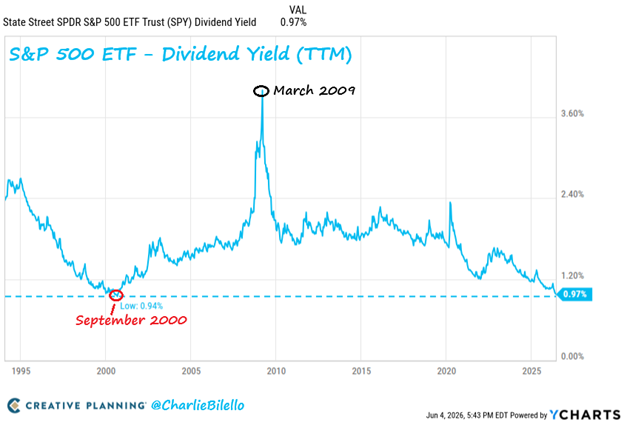
Simply investing in the S&P 500 today yields less than 1%, near historic lows set at the height of the dotcom boom. (Source: Charlie Biello/ Creative Planning)
Wharton professor Jeremy Siegel first revealed in Stocks for the Long Run: Dividends matter. Many studies have followed suit.
Specifically, reinvesting dividends.
Dividend-paying stocks are a central feature in the Grey Swan Model Portfolio for a reason. Rather than get caught up chasing the tech mania, buying stocks “high” and hoping to sell them “higher,” we prefer good, solidly run businesses that can back up their performance by paying dividends.
Over the long run, investors who reinvest dividends build wealth through market rallies and crashes. The strategy helps you sleep well at night. Or take a day or two away from the financial headlines without worrying what your stocks are up to at every twist in the news.
Dividends – cash payments – help smooth out investment returns. You can use them to buy more shares of stocks in down years, adding assets to your portfolio, and compounding your stock investments over time.
There’s a big difference between a 1% return and the 2% average – or even the 3%-plus that mark generational market lows, like in early 2009.
With growth stocks stealing the headlines – and accounting for most of the market’s returns – dividend stocks are out of favor today. That’s a good thing for dividend investors, right now. Prices across the 490 stocks that don’t make up the 10 most speculative are at historic or even lower P/E levels.
Building a portfolio that generates income is far less susceptible to a wipeout than simply chasing today’s hot stocks. At the very least, the cash flow from stable, steady businesses will keep your portfolio healthy – and keep you sane – any time the AI trade goes awry.
Furthermore, you don’t have to hang on every Truth Social post about the midterms or the not-so-peaceful arrangement in the Persian Gulf. Unless, of course, you want to.
To get started you’ll find a specific way to play the current imbalance in income stocks compared to growth stocks, with a common stock paying a safe yield over 6%, in today’s Grey Swan Pro — details here.
~ Andrew
P.S. Last week on Grey Swan Live!, Mark Jeftovic joined us to cover the latest developments in the crypto space – including the Clarity Act and the Fate of Dollar 2.0.
Crypto has taken a back seat to the AI trade in recent weeks, but those lamenting crypto’s poor performance may not have much longer to wait, with so many positive catalysts on the horizon.
Mark’s conversation revealed when this crypto bear market is likely to end, the positive catalyst potential from the Clarity Act and how to set up your business so you can get paid in crypto during this bear market.
The replay is up on site for our members who weren’t able to join live.

If you have any questions for us, send them to Feedback@GreySwanFraternity.com.