
Since the Iran attack began, global markets have been chaotic. South Korea, which had spiked higher, crashed, declining 20% in two trading days. After circuit breakers were triggered Monday, Dubai’s stock market opened 10% lower on Tuesday.
And despite some wild intraday swings this week, the U.S. stock market has held up well.
When bombs go flying, capital moves from frontier markets to safer shores. And even though the U.S. has been the one to aggressively move against Iran, capital that was going to foreign markets has shifted back to New York:
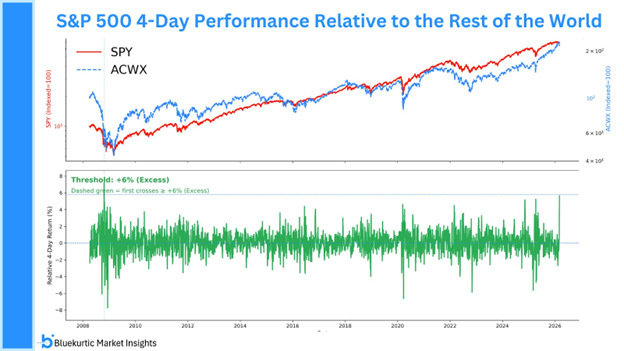
This week has seen a substantial shift in global assets out of foreign markets and into the U.S. (Source: Bluekurtic Market Insights)
In a global crisis, U.S. safety trumps foreign fears. And despite legitimate concerns over AI capex spending, private credit cockroaches and weakness across global bond markets, the shift to U.S. stocks this week has occurred at its fastest pace since the global financial crisis in 2008.
As a minor consequence, the dollar index rallied 5%. Money moving into U.S. markets requires dollar liquidity.
~ Addison
P.S. There aren’t too many conversations we have that will shake your worldview and make you rethink your assumptions about the market and the economy. Yesterday’s Grey Swan Live! with John Robb, author of Brave New War and a Grey Swan Investment Fraternity contributor, did just that.
John’s analysis of the U.S. military strikes in Iran and their strategic decision to decapitate the Iranian regime is fraught with unknown unknowns we hadn’t yet considered. That’s the value of having a former advisor to the Joint Chiefs of Staff on kinetic network warfare in the fraternity.
The conversation sent Andrew and I into the futures markets looking for ways to isolate portfolio risks should the U.S. and Israeli bombardments fail to restrain a decentralized and highly motivated, mobile Iranian drone network.
Passage of oil and natural gas through the Strait of Hormuz has been paralyzed for an indeterminate period, and the longer prices rise, the more insatiable global financial markets and the U.S. domestic economy will become.
John covered the strategy employed against Iran, its impact on neighboring countries, and what it means for the dollar and other assets. His analysis was shocking and sobering:
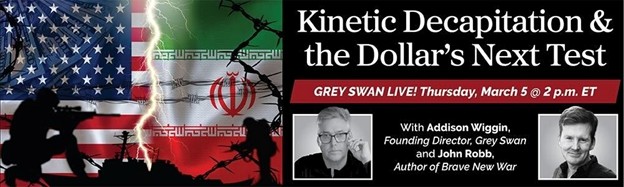
Robb’s expertise on network warfare is central to understanding the Trump strategy for killing 40 top Iranian leaders and what’s likely to happen next. The methods, technology and strategy of open warfare have changed dramatically since the Russian invasion of Ukraine in 2020.
If you were unable to attend, it’s worth your time to click on the replay. We’ll have the video up on site later today for members. If you’re not yet a member, click here to sign up and join the fraternity today so you can get caught up on the war and the longer-term implications as the missiles and headlines currently fly.