

GSI Banner
  • Free Access
  • Contributors
  • Membership Levels
  • Grey Swan Forecasts
  • Video
  • Origins
  • Sponsors
  • My Account
  • Sign In
  • Join Now

  • Free Access
  • Contributors
  • Membership Levels
  • Grey Swan Forecasts
  • Video
  • Origins
  • Sponsors
  • Contact

© 2026 Grey Swan Investment Fraternity

  • Cookie Policy
  • Privacy Policy
  • Terms & Conditions
  • Do Not Sell or Share My Personal Information
  • Whitelist Us
Ripple Effect

“AI” Tops “Earnings”

Addison WigginAddison Wiggin

March 18, 2026 • 1 minute, 2 second read


AIbig techEarnings

“AI” Tops “Earnings”

With traders and investors focused on the power of AI, it’s no surprise that corporate executives are willing to tell them what they want to hear.

Mentions of AI have not only surged on earnings calls – they’ve topped the term “earnings” itself:
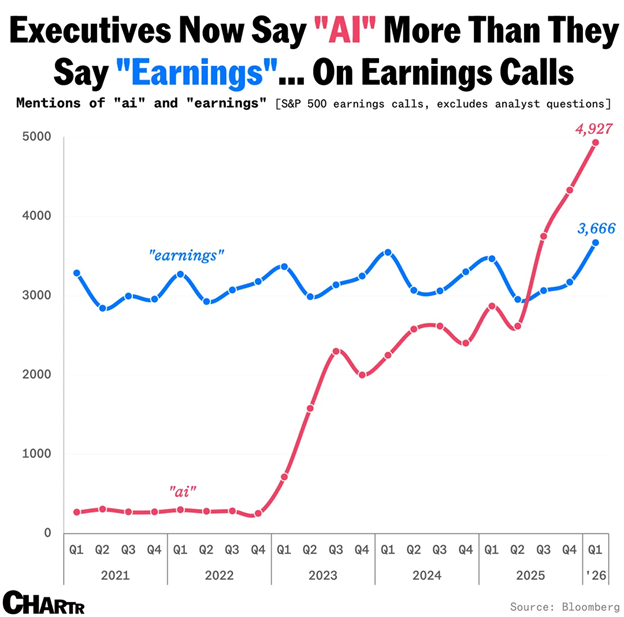

AI continues to drive the narrative on Wall Street, particularly during earnings calls. (Source: Chartr)

With many tech stocks now spending more than 100% of their free cash flow on AI projects, the fear is things may turn nasty.

The recent rally in AI stocks stoked investors’ concerns that prices for tech stocks had gone higher than earnings from the companies justify. 

That the calls are buzzing with questions about productivity gains and overinvestment is a good sign that investors are trying to be realistic about what the tech actually produces.

Are they…? The question remains. 

Worst case, management teams feel they need to have a competitive strategy in AI — whether needed or not — just to keep shareholders happy.

~ Addison

P.S. This week in Grey Swan Live!, at 2 p.m. ET/11 a.m. PST, we’ll be joined by our natural-resources specialist, Shad Marquitz, for a prescient look at volatility and opportunity in oil, energy, rare earths and precious metals following the Iran bombing excursion.


Copper’s Clear Signal

August 17, 2026 • Addison Wiggin

Copper and resources are sending us a cleaner market signal than AI stocks.

Channeling Ludwig von Mises, we observe this morning that price is not just a number; it’s information. Price reflects what buyers and sellers collectively believe: demand, scarcity, fear, speculation, disappointment, future expectations and available supply.

When prices rise, and inventories fall at the same time, the message is usually straightforward: buyers need the stuff, and there is not enough of it.

Copper’s Clear Signal
Market Crash Insurance Is Cheap

August 14, 2026 • Addison Wiggin

A low VIX does not predict disaster. It measures complacency. A serial skeptic will read it as the calm before a storm. We shook off that feeling this morning and opted to pursue an opportunity instead.

Here goes:

A VIX reading below 15 means the market is not pricing in much near-term trouble, even though there are obvious risks still sitting in the room: Iran, oil prices, memory chip speculation, circular financing, high valuations, epic high concentrations, spiking long-term interest rates, a regime change at the Fed, a meltdown in Japan and a historic deficit and rising national debt.

Market Crash Insurance Is Cheap
Beware: Financial Innovation In AI

August 13, 2026 • Addison Wiggin

Money is not flowing in a clean, straight line from outside investors to productive businesses. The firms at the top are investing in and buying from each other.

Microsoft and OpenAI are the easiest examples to follow.

Microsoft says OpenAI has contracted to purchase an additional $250 billion in Azure services, while Microsoft continues to account for $13 billion in funding commitments to OpenAI as an investment.

Beware: Financial Innovation In AI
Signs of a Late-Stage Bull Market

August 12, 2026 • Addison Wiggin

At this stage, it’s a stock picker’s market.

We expect space, robotics and some more visible tech startups to remain sources of speculation. After weakness in the first half of 2026, we’re also due for a strong rotation of capital into natural resources, precious metals, critical minerals and energy.

Signs of a Late-Stage Bull Market