GSI Banner
  • Free Access
  • Contributors
  • Membership Levels
  • Grey Swan Forecasts
  • Video
  • Origins
  • Sponsors
  • My Account
  • Sign In
  • Join Now

  • Free Access
  • Contributors
  • Membership Levels
  • Grey Swan Forecasts
  • Video
  • Origins
  • Sponsors
  • Contact

© 2026 Grey Swan Investment Fraternity

  • Cookie Policy
  • Privacy Policy
  • Terms & Conditions
  • Do Not Sell or Share My Personal Information
  • Whitelist Us
Ripple Effect

Who’s Buying The Dips?

Loading ...Addison Wiggin

May 20, 2025 • 55 second read


Who’s Buying The Dips?

Markets opened lower on Monday, but closed the day green. Why? Because retail investors continue to aggressively buy market dips.

In the morning, yesterday, an analyst at Morgan Stanley suggested that any drop following Moody’s downgrade of U.S. credit from AAA to Aa1 would be temporary.

Sure enough, investors came into the market in droves by lunchtime.

But what’s most interesting in our current V-shaped market recovery is what’s missing: The Federal Reserve.

Turn Your Images On

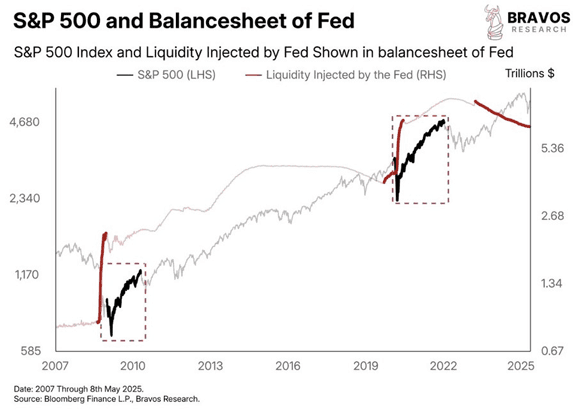
During the 2020 and 2008 bear markets and V-shaped recoveries, the most significant driver wasn’t retail investors – it was policymakers, opening up the monetary spigots.

Both times, the Federal Reserve’s balance sheet soared.

Perversely, the lack of monetary intervention in this market bounce is good news. Investors are pushing markets higher, not money created out of thin air.

Markets may make a new all-time high in the coming weeks at the rate they’re going.

But if you’ve got a bit of contrarian in ya, markets pushing higher on retail buying is likely also raising the hair on the back of your neck a bit. Caveat emptor.

-Addison

Slaughterhouse-Five

February 13, 2026 • Addison Wiggin

Mustafa Suleyman, who leads Microsoft’s AI initiatives, told the Financial Times that most white-collar professional tasks could be automated within 12 to 18 months.

Lawyers, accountants, marketers, project managers — anything related to desk work faces compression.

Challenger data showed 7,624 January layoffs attributed directly to AI — about 7% of the month’s total. Since 2023, AI has been linked to nearly 79,500 announced job cuts. Morgan Stanley’s Stephen Byrd cautioned clients that measurable macroeconomic impact may lag several years.

In Silicon Valley, Mercor quietly hired tens of thousands of highly credentialed contractors at $45 to $250 per hour to train large language models for OpenAI and Anthropic.

Slaughterhouse-Five
Stealth Correction

February 13, 2026 • Addison Wiggin

Despite a stock market within 3% of its all-time highs, your portfolio likely feels a bigger pinch right now.

Fears of high spending on AI are leading to another pullback in the market’s biggest names. The Mag 7 stocks are collectively 10% off their peak, and now in correction territory.

Stealth Correction
A Tale of Two Economies

February 12, 2026 • Addison Wiggin

Private education and health services accounted for the bulk of job creation over the past year.

Over the last twelve months, that category added roughly 780,000 positions. Excluding those gains, the economy shed approximately 350,000 jobs.

Manufacturing, the purported object of Trump’s tariff strategy, declined by about 100,000 in 2025. Transportation and warehousing fell by more than 100,000. Professional and business services contracted. Information and financial activities declined.

Federal employment dropped again in January, down 42,000. The civilian federal workforce now sits roughly 11% below its October 2024 peak.

A Tale of Two Economies
S&P Earnings Yield Hit 100 Year Lows

February 12, 2026 • Addison Wiggin

Most investors are familiar with the price-to-earnings, or PE, ratio. But what if you invert that, and divide earnings by price? You get what’s  called the “earnings yield.”

Earnings yield on the S&P 500 is near a 100-year low.

S&P Earnings Yield Hit 100 Year Lows