GSI Banner
  • Free Access
  • Contributors
  • Membership Levels
  • Grey Swan Forecasts
  • Video
  • Origins
  • Sponsors
  • My Account
  • Sign In
  • Join Now

  • Free Access
  • Contributors
  • Membership Levels
  • Grey Swan Forecasts
  • Video
  • Origins
  • Sponsors
  • Contact

© 2026 Grey Swan Investment Fraternity

  • Cookie Policy
  • Privacy Policy
  • Terms & Conditions
  • Do Not Sell or Share My Personal Information
  • Whitelist Us
Ripple Effect

Warsh to Rock the Boat – Just Not Yet

Addison WigginAddison Wiggin

June 17, 2026 • 1 minute, 39 second read


central bankFederal ReserveInflationkevin warsh

Warsh to Rock the Boat – Just Not Yet

Traders are on edge about Kevin Warsh’s first meeting at the Federal Reserve. Predictions markets expect him to announce the FOMC will keep interest rates unchanged today. 

The real fireworks come later. 

You may have seen one of these charts over the past few days, showing how markets have sold off when a new central bank head has come into office:
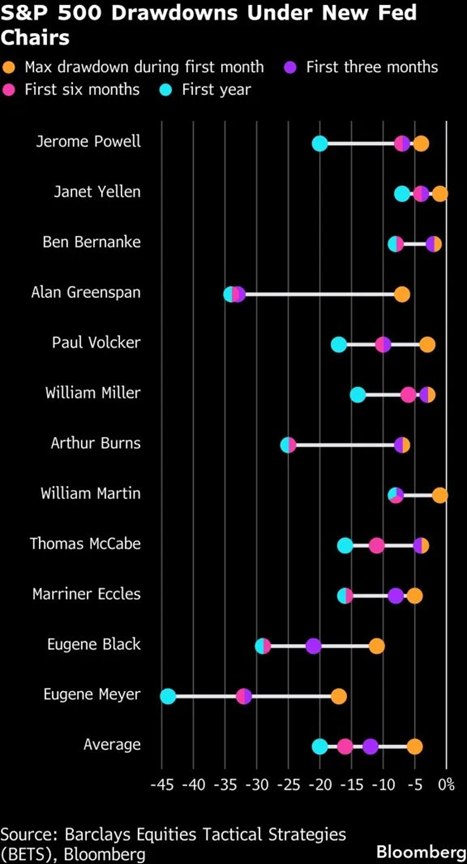
Although the markets often face a moderate decline within the first year of a new Fed Chair, the worst of those declines happened during the Depression. (Source: Bloomberg)

Alan Greenspan took over just in time for the Crash of ‘87. And despite the market’s one-day decline of 22%, the stock market ended the calendar year higher.

It’s Eugene Black (1933 to 1934) and Eugene Meyer (1930 to 1933), who juice the stats in terms of negativity. 

Meyer caught the market in freefall from the Crash of ‘29, and although stocks hit their lows in 1932, they were hardly back to a V-shaped bounce that investors are used to today.

Warsh has some radical ideas about restructuring the Fed. But he needs to walk a fine line. Headline Inflation rose to 4.2% in May, the highest print since 2023. Warsh’s restructuring will directly address the Fed’s inability to impact or “control” inflation at all.

We’ll know more this afternoon, but after the wild ride markets have had this year, even a small pullback would be welcome to squeeze the speculative capital out of the markets.

Today’s Grey Swan Pro covers a company that pays investors growing income. It’s structured to increase its revenues as inflation rises, but shares could also pop if interest rates go lower. It’s the perfect way to stay invested for whatever happens next in this market — details here.  

~ Addison

P.S. Tomorrow on Grey Swan Live!, Ian King joins us to discuss the latest in the AI trade, what it means for our Dollar 2.0 thesis and what America’s future looks like we prepare to celebrate America’s 250th.


One Sign that Government Spending Is At a Crisis Point

August 7, 2026 • Addison Wiggin

Debts and deficits will eventually cause a crisis. Treasury Secretary Scott Bessent’s effort to help bail out the Japanese Yen this week is entirely motivated by self-preservation. The contagion signal flashing in Japanese bonds since late ‘25 is infecting the BOJ, which may be forced to sell U.S. Treasurys to stabilize its own currency.

One Sign that Government Spending Is At a Crisis Point
“Doc” Copper Tests Positive for Testosterone

August 6, 2026 • Addison Wiggin

The copper price is no doubt benefiting from inflation driven by money printing. But the doc don’t lie. Copper’s new all-time highs, while gold and silver still languish, are a sign the AI growth story is also that of the global economy itself.

“Doc” Copper Tests Positive for Testosterone
Gold Mining Stocks Still Big Winners Amid the Price Pause

August 5, 2026 • Addison Wiggin

Many miners were profitable with gold around $2,000 and silver near $50. At sustained prices closer to $4,000 gold and $60 silver, the arithmetic changes dramatically.

Gold Mining Stocks Still Big Winners Amid the Price Pause
The “Yentervention” Kicks US Markets Into High Gear

August 4, 2026 • Addison Wiggin

The stock market is getting an unexpected boost to kick off August, bucking the historically weak summer session for the U.S. stock market.

What’s happening? The Bank of Japan and the U.S. Treasury are making a coordinated effort to support Japanese yen; a move last attempted nearly 30 years in the height of the Asian Financial contagion (1998).

The “Yentervention” Kicks US Markets Into High Gear