GSI Banner
  • Free Access
  • Contributors
  • Membership Levels
  • Video
  • Origins
  • Sponsors
  • My Account
  • Sign In
  • Join Now

  • Free Access
  • Contributors
  • Membership Levels
  • Video
  • Origins
  • Sponsors
  • Contact

© 2025 Grey Swan Investment Fraternity

  • Cookie Policy
  • Privacy Policy
  • Terms & Conditions
  • Do Not Sell or Share My Personal Information
  • Whitelist Us
Ripple Effect

The U.S. Falls Behind China in Resource Development

Loading ...Addison Wiggin

July 23, 2025 • 1 minute, 35 second read


Chinanatural resourcesU.S.

The U.S. Falls Behind China in Resource Development

A new economic narrative has started building in recent weeks.

Following the announcement that the Department of Defense would take a stake in MP Materials (MP), a rare earth developer exclusively in North America, it’s clear that the U.S. sees domestic resource development as a key part of national defense.

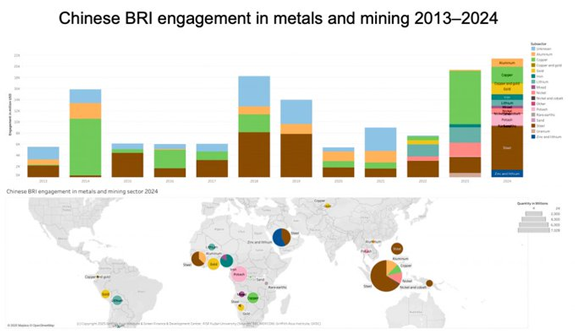
However, the move, while shaking the small resource market, pales in comparison to the hefty investments that China has been making in the metals and mining space for over a decade:
Turn Your Images On

China has made extensive global investments in resource developments.

Currently, resources make up about 2% of the S&P 500 by market cap. Even today’s big-name gold miners carry market caps of under $100 billion, and the entire resource space is valued at less than any of the Magnificent Seven names.

But these are the critical physical commodities the world needs. Copper, gold, lead, zinc, uranium, and the rare earths.

This story is just getting started, and U.S. developers may see big moves ahead as the U.S. looks to catch up from a decade of underinvestment as China has moved full steam ahead with resource development.

~ Addison

P.S. With the resource market taking off, we’ve asked Grey Swan Contributor Shad Marquitz, to join us again on Grey Swan Live! tomorrow, July 24 @ 11 a.m. ET.

Shad regaled us last time with a litany of tickers he likes in the natural resource space. We covered rare earth minerals, uranium and nuclear energy, precious metals and building materials.

Tomorrow’s call will give us a chance for another full run down with Shad. He’s very articulate on investing in natural resources. If you’re interested in this overlooked space that’s starting to heat up again, you’ll want to join us Live!

As always, your reader feedback is welcome: feedback@greyswanfraternity.com (We read all emails. Thanks in advance for your contribution.)


Joe Withrow: The Hollow Class, Part III

November 13, 2025 • Andrew Packer

What we’ve seen since 2008 is nothing short of a theft of the commons. Except it happened in little pieces that seemed unrelated at the time. But if we look at the story holistically, it all comes together.

When we step back and view the entire picture, what emerges is not just a story of market excesses and economic shifts. What we see is the gutting of middle America – be it intentional or otherwise.

Now the question is – are we going to see the restoration of the American middle class in the coming years… or are we going to watch everything devolve into a modern redux of the War Between the States, more commonly but mistakenly known as the American Civil War?

Joe Withrow: The Hollow Class, Part III
Performative Clowns

November 13, 2025 • Addison Wiggin

Today’s Washington isn’t governed so much as stage-managed.

Politicians don’t solve problems; they perform them.

The current fixation is affordability — a word that will be repeated ad nauseam from now through the 2026 midterms, until it becomes as meaningless as “bipartisan.”

The script hasn’t changed in decades: promise relief, pass a law that raises costs, blame capitalism, hold hearings, fundraise, repeat.

Performative Clowns
A Bubble in Bubble Talk

November 13, 2025 • Addison Wiggin

Yes, Nvidia’s profits are up 500%, and its share price followed suit — a rare case where the story actually matches the math. But that’s the exception, not the rule.

Beneath the headlines, we’re starting to see the kind of financial gymnastics — circular lending, balance-sheet origami, and creative “partnerships” — that usually signal the boom is running out of breath.

If history rhymes, it looks like we’re closing in on the tail end of a mania.

A Bubble in Bubble Talk
The Hollow Class, Part II

November 12, 2025 • Addison Wiggin

As interest rates fell, investors swarmed into real estate, lured by yields and the illusion that home prices never fell. Wall Street’s private-label securitizers were soon packaging everything from pristine mortgages to what were effectively loans scribbled on napkins, thus turning them into bonds that glowed like gold — until you looked too closely.

For their part, the regulators and ratings agencies conveniently looked away and allowed the bubble to grow. Fannie Mae watched the frenzy from the sidelines at first.

The company’s mandate — written in law — was not to chase profits but to promote affordable housing. That is to say, to make sure that teachers, nurses, and other first-time buyers could own their own homes and unlock the American Dream.

But as Wall Street flooded the market with high-risk mortgage products, political pressure mounted. Congress demanded that Fannie “do its part” for low and moderate-income families.

The Hollow Class, Part II