Ripple Effect
The “Trade of the Decade” Still Has Room to Run

June 22, 2026 • 2 minute, 47 second read

Wall Street has developed a nasty habit over the past decade. Every time stocks stumble, investors rush in like bargain hunters at a department-store liquidation sale.
In 2026, a 1% decline qualifies as a buying opportunity for some traders. Five percent is enough to trigger excitement among the more cautious crowd. Those of us bothering to look at a stock’s 200-day moving average know that reasonable value takes a little bit longer.
The remarkable part isn’t that investors “buy the dip.” It’s the record amount of capital being willingly handed over to Wall Street:
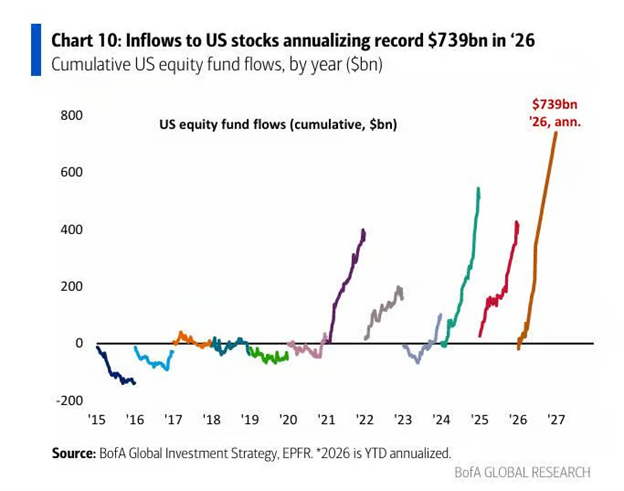
A massive “passive bid” every other week as 401(k) plans make their investments has lulled retail investors into buying the overcrowded tech sector on every pullback, however slight. (Source: Bank of America Global Research)
A recent Bank of America study detailed the incentive behind the “buy the dip” phenomenon. While the steady machinery of passive investing continues to operate in the background, investors have become accustomed to quick recoveries after sell-offs.
Every pay period, millions of workers contribute to retirement accounts. Every pay period, those contributions are invested in index funds. Every pay period, index funds buy more of whatever already occupies the largest weighting.
The market averages continue making headlines. Technology companies continue attracting attention. Artificial intelligence remains the financial media’s favorite dinner guest. That process has rewarded investors who were early in the AI trade for several years.
“What’s wrong with that?”
Nothing. That is, if you’re aware that’s the game you’re playing.
At high valuations, with no foreseeable profits and low dividends, if any, many “buy the dip” investors are lulled into buying at a high price. The only way to make money if you buy at a high valuation is to sell to some “greater fool” at an even higher price.
Of course, Wall Street loves it. They get to take your money and send you a bill for the trouble. Each record index close is a reason for them to celebrate.
Meanwhile, sectors that still produce the things the real economy needs have been left sitting alone at the far end of the table. Even with the rising demand from data centers and crypto miners, energy still accounts for only 3.2% of the S&P 500 Index.
On-again, off-again peace talks in the Middle East have knocked oil back to $74 a barrel (WTI), but at that price, producers are flush with cash and reinvesting in infrastructure.
In a market dominated by tech stocks, low dividend yields, “energy” is cheap. And pays dividends. You can buy into the sector and earn money. If the stock price rises, that’s a bonus. You’re not depending on the next buyer to cash you out.
The mainstream media considers energy a contrarian play. We’ve been long “long oil” since the pandemic sell-off in 2020. It’s still a buy.
Today’s Grey Swan Pro covers a leader in North America energy distribution, a critical player ensuring that energy resources get where they need to go, and shares pay a hefty dividend north of 5% — details here.
~ Addison
P.S. Last week on Grey Swan Live!, Ian King joined us to discuss the latest in the AI trade, what it means for our Dollar 2.0 thesis and what America’s future looks like as we prepare to celebrate America’s 250th.