

In a market crisis, banks go first. In 2008, it was the housing market and mortgage-backed securities. In 2023, the mispriced risk of owning Treasurys when inflation got out of hand, specifically in banks with ties to Silicon Valley venture capital funds.
The next crisis? Outsized exposure to hedge funds during the AI boom.
Historically, “hedge funds” were set up to help investors “hedge” against grey swans that blow up the prevailing investment theme.
At least, that’s what they used to do.
Today, hedge funds are the go-to tool for leveraging up on the dominant trend, the exact opposite of hedging your bets.
Wall Street banks are all too happy to play along:
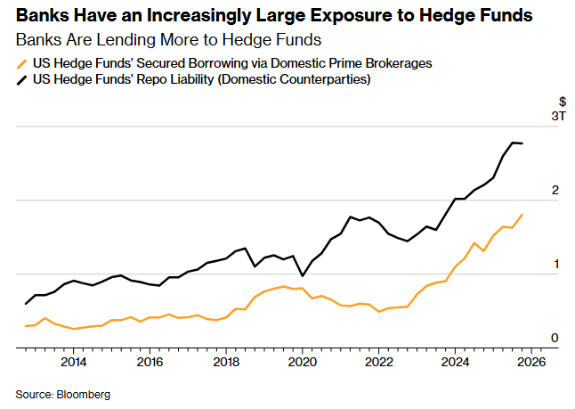
Banks continue to make, well, bank, by lending to hedge funds so they can make riskier bets. (Source: Bloomberg)
Globally, hedge fund leverage is approaching $2 trillion. And counterparty risk between hedge funds and their constituent banks is closer to $3 trillion.
The number is more than double the 2019 spike before the pandemic collapse. But the trend was already well documented. In 2023, the rate of borrowing and speculating kicked off a multi-year uptrend.
What to watch: Hedge funds are a speculator’s game. And they proliferate in bull markets.
On their clients’ behalf, hedge funds are chasing the big score. Across the field, 80% of them fail to beat a passive market index. But for fund managers, it’s worth the squeeze. The typical fund charges wealthy clients 2% of assets under management and 20% of all profits.
The fee structure encourages the funds to accumulate as much capital and debt as possible and swing for the fences. Often. The business can turn into a disaster on one failed bet.
In the fourth year of a bull market, tense with the uncertainty of a midterm year, this debt load is worth keeping an eye on.
Today’s Grey Swan Pro looks at a financial company avoiding exposure to the growing dangers of soaring leveraged bets, with a strong management team, 3.5% dividend yield, and a compelling valuation today — details here.
~ Addison
P.S. On Thursday, for Grey Swan Live!, we’ll be tapping Shad Marquitz’s expertise in precious and industrial metals, mining and energy to zero in on the base layer of Jensen Huang’s “5-Layer Cake” – strategy for the AI intelligence economy buildout.
Specifically, the “Sovereign Bloc” strategy established when President Trump issued an executive order establishing Project Vault.
Background: The 5-Layer Cake is a bottom-up supply chain strategy focused on physical technology and infrastructure. The Sovereign Bloc is a geopolitical risk strategy focused on domestic resilience, national control, and regional trade ties.
If the 5-Layer Cake strategy is about owning the best flour, ovens, and frosting recipe to make a highly profitable treat, the Sovereign Bloc is about a country deciding it wants to own the bakery and grow its own wheat, so no other country can stop it from eating.