
Oh… the SpaceX IPO?
Well, yes, that too.
By this time next week, Wall Street will be obsessing over Elon Musk again. Analysts will debate valuations. Television anchors will speculate about opening-day pricing. Investors will argue over whether the largest IPO in history deserves an even larger market capitalization.
We’ll get to all that soon enough.
Tomorrow, however, the 2026 FIFA World Cup kicks off with Mexico facing South Africa, and there is plenty to be excited about.
This year’s tournament features 48 teams, the largest field in the competition’s 96-year history.
Matches will be played across three countries — the United States, Canada and Mexico — and a record sixteen cities.
It will also be the first World Cup in which billionaires take the field.
Cristiano Ronaldo, now 41, captains Portugal. Lionel Messi, 38, leads Argentina’s title defense. Somewhere in the tournament, an eighteen-year-old superstar most Americans have never heard of will probably become a household name before the month is over.
⚽ Seventeen Years On The Sidelines
You’ll forgive our excitement.
Our sons, now 26 and 22, both played highly competitive soccer. Each reached a national championship match at least once. For reasons nobody has ever fully explained, the Philadelphia-Baltimore-Washington corridor became a remarkably productive incubator for soccer talent.
In the early 2000s, we simply wanted the boys to learn the game, burn off some energy and spend less time staring at screens. What followed was 17years of practices, tournaments, training sessions and road trips. We played all over the Northeast, Florida, Texas, Missouri, Illinois, Arizona, California and probably a few more…
We spent evenings and weekends on soccer pitches throughout the Mid-Atlantic. We stood in the rain. We stood in the cold. We stood in the August humidity that settles over Maryland and Virginia like a wet wool blanket. We shouted encouragement from the sidelines and occasionally advice that neither referees nor teenage boys seemed particularly interested in hearing.
It was quite a ride.
As a consequence, we’re probably more excited than the average American about the United States, Canada and Mexico co-hosting the world’s largest sporting event. Over the next month, billions of people will tune in. Airports will fill. Hotels will fill. Restaurants will fill. Broadcasters will collect billions of dollars. FIFA will generate enough revenue to make Silicon Valley venture capitalists nod approvingly.
That brings us to the chip on our shoulder.
The World Cup offers a perfect opportunity to revisit one of the most misleading statistics in modern economics.
Over the next several weeks, consulting firms will publish estimates showing how much the tournament generated in spending. Politicians will cite the numbers. Local officials will celebrate them. Economists will fold them into gross domestic product (GDP) calculations. The spending will be real. The receipts will be real. The accounting will be real.
What won’t necessarily be real is the prosperity those numbers supposedly represent.
That confusion sits near the center of modern economic policy. It also helps explain how Washington accumulated roughly $39 trillion in debt while continuing to assure the public that everything remains manageable. The justification almost always comes back to GDP. As long as the debt remains a reasonable percentage of GDP, we’re told, there is little cause for concern.
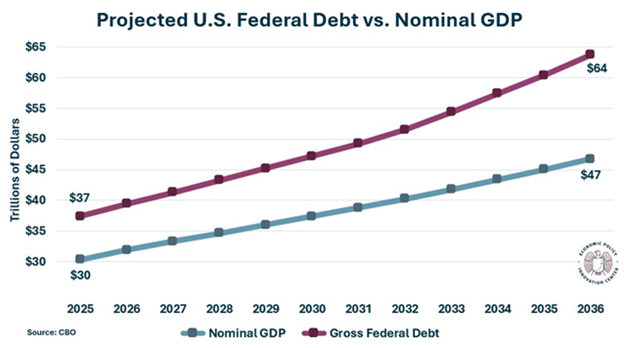
The U.S. government has turned borrowing into an art form. The national debt keeps setting new records, interest payments keep rising, and yet Washington’s solution remains remarkably consistent: borrow more and worry about it later. (Source: CBO)
The argument sounds reassuring until you notice that borrowed money helps create the GDP being used to justify the borrowing in the first place.
That’s where today’s story begins.
📊 Host Cities Publish Economic Impact Forecasts
Dallas expects more than 1 million visitors during the tournament. Philadelphia, Atlanta, Los Angeles and Miami have published similar forecasts. Local governments commissioned economic-impact studies years ago. Consulting firms estimated hotel occupancy, restaurant spending, tax receipts and employment gains associated with hosting matches. By the time the first ball is kicked in Mexico City, much of the tournament’s economic footprint will already have moved through engineering firms, construction contractors, equipment suppliers and municipal budgets.
None of this is particularly controversial. Visitors spend money. Businesses receive revenue. Workers receive wages. Local governments collect taxes.
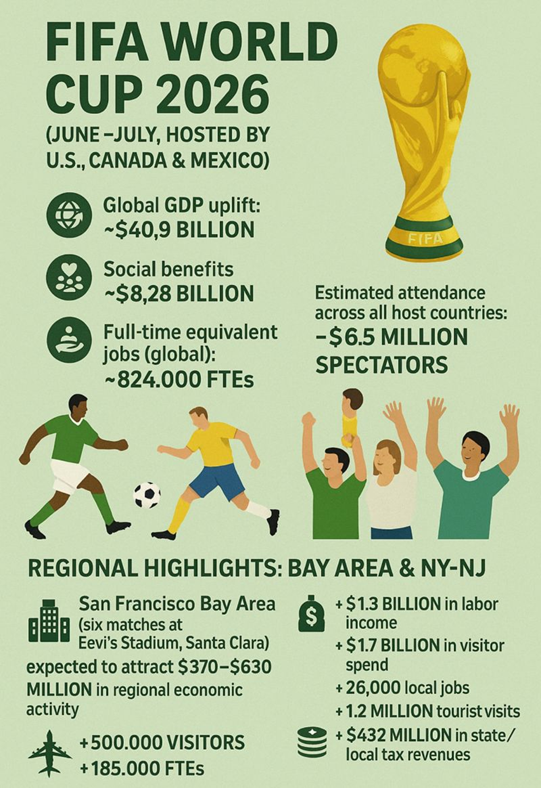
For host cities, the World Cup is part sporting event, part economic experiment. From tourism and infrastructure investment to local business spending, the tournament can provide a significant short-term boost for host cities while showcasing them to a global audience of billions. (Source: WorldSBN)
The trouble begins when spending quietly assumes a second identity and masquerades as wealth creation.
Simon Kuznets understood the difference. During the Great Depression, he helped construct the national income accounts that eventually became modern GDP. The purpose was straightforward: policymakers needed a way to measure economic activity. Factories produced goods. Consumers spent money. Businesses invested capital. GDP provided a useful way to keep score.
Like most scoreboards, however, it was only designed to record certain things.
A stadium scoreboard can tell you who won the match. It cannot tell you whether the owner mortgaged the stadium to keep the lights on.
💵 When Debt Becomes Growth
The federal government now owes roughly $39 trillion.
Whenever concerns arise about that number, defenders of the status quo almost immediately reach for debt-to-GDP ratios. The conversation shifts from the debt itself toward the size of the economy supporting it.
At first glance, the argument sounds sensible. A larger economy should be capable of carrying more debt than a smaller one.
The difficulty emerges when you examine how much of that economic activity is itself financed through borrowing.
Congress authorizes spending that tax revenues cannot cover. Treasury issues debt. The money moves through agencies, contractors, grant programs, procurement contracts and payrolls. Construction projects begin. Consultants are hired. Equipment is purchased. Wages are paid. The resulting activity is included in GDP because GDP is designed to measure economic activity.
Years later, policymakers point to the larger economy as evidence that the debt remains manageable.
The circularity would be easier to spot if it occurred inside a household.
Imagine borrowing against your home to build an addition, renovate the kitchen and install a swimming pool. Contractors arrive. Landscapers arrive. Appliance deliveries arrive. The value of the property may rise. The mortgage balance certainly rises. If the homeowner then points to the larger appraisal as evidence that the additional debt isn’t really a problem, most people would recognize the argument for what it is.
Since Ronald and Nancy danced in the White House ballroom, the old one, the federal enterprise HQ’d in Washington, D.C., has been running a variation of that exercise on a historically epic scale.
For many years, the arrangement worked because interest rates remained low and foreign buyers absorbed enormous quantities of Treasury debt. Financing costs remained manageable. Deficits accumulated quietly in the background.
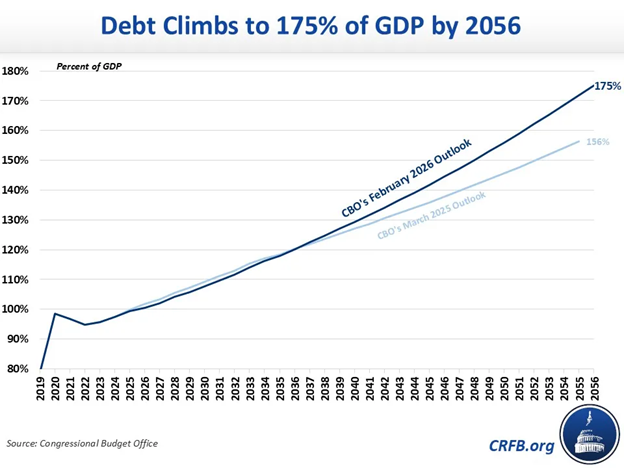
America’s debt-to-GDP ratio has been moving in the wrong direction for years. As debt grows faster than the economy itself, investors are increasingly paying attention to what that could mean for growth, interest rates and future government spending. (Source: CBO)
Today, the government spends more than a trillion dollars annually servicing debt. Treasury refinances obligations at a time when markets demand significantly higher yields than they did a decade ago. Interest costs have become one of the fastest-growing items in the federal budget, yet the same GDP statistics, inflated by years of spending, continue to serve as evidence that everything remains under control.
The magician’s trick works best when the audience focuses on the rabbit instead of the hat.
⚡ Data Centers Increase Utility Demand
While economists prepare World Cup forecasts, utility executives are wrestling with a different set of spreadsheets.
Data-center developers continue requesting electricity at a pace that would have sounded absurd five years ago. Utilities are revising demand projections. Transformer manufacturers report delivery schedules stretching years into the future. Semiconductor facilities under construction in Arizona, Texas and Ohio continue consuming billions of dollars before producing their first commercially useful chip.
Artificial intelligence dominates headlines because software demonstrations are easy to film.
Substations are less cooperative.
The companies financing this buildout are purchasing turbines, transformers, switchgear, cooling systems and generation capacity. Utilities are expanding grids. Manufacturers are increasing production. Engineers are redesigning networks. The physical infrastructure supporting the AI economy increasingly resembles an industrial mobilization conducted without uniforms.
The cloud remains attached to the ground by an astonishing amount of copper, steel, concrete and debt.
From these data centers, the collective gamble goes, will spring enough wealth to kick the debt down the road once again.
🔥 June 10, 1692: Bridget Bishop Is Executed
Back to the SpaceX IPO.
In his classic book, Scottish journalist Charles Mackay describes the “madness of crowds” as a contagious psychological phenomenon where whole societies and groups of people abandon reason and critical thinking to behave irrationally, blindly following mass hysteria, speculative manias, and popular delusions.
Mckay famously observed that “Men, it has been well said, think in herds; it will be seen that they go mad in herds, while they only recover their senses slowly, and one by one.”
He did not view a crowd as a physical gathering, but rather as widespread public opinion or mass hysteria. He argued that a collective delusion can sweep through an entire population regardless of social class, education, or intelligence.
In economic contexts – 17th-century Dutch Tulip Mania or the South Sea Bubble – he described how crowds are blinded by the dream of sudden wealth, eagerly ignoring fundamental value and succumbing to speculative fever.
By cataloging centuries of manias, witch hunts, alchemy, and Crusades, Mackay demonstrated that crowd-driven irrationality is a timeless component of human nature that repeats across generations
One such episode occurred 334 years ago today. That’s the day Bridget Bishop was hanged in Salem, Massachusetts.
The surviving records remain fascinating because the institutions involved behaved exactly as institutions tend to behave. Witnesses testified. Officials documented evidence. Hearings were conducted. Procedures were followed. The process appeared orderly and authoritative to the participants.
The flaw existed much earlier.
Once spectral evidence became accepted as legitimate, the machinery that followed became extraordinarily efficient at producing the wrong answer.
Historians continue to return to Salem because it illustrates how institutions can become remarkably effective at measuring what they do not fully understand. The records were meticulous. The assumptions were disastrous.
Kuznets, the father of GDP, worried about a different version of the same problem. Economic statistics were useful tools. Problems emerged when governments began treating those tools as substitutes for judgment.
Tomorrow night, economists will begin estimating visitor spending associated with the World Cup. Airport operators will count passengers. Hotels will count reservations. Municipal officials will count tax receipts. The reports will be detailed, professional and widely cited.
Meanwhile, eighty thousand people will be watching a soccer match in Mexico City.
~ Addison
P.S. FIFA expects more than five billion people to engage with some portion of the World Cup before the final whistle. The U.S. Treasury expects to refinance hundreds of billions of dollars of debt during roughly the same period. Both organizations keep remarkably detailed records.

This week on Grey Swan Live!, we’ve got our eyes on the SpaceX IPO… just like everyone else. Be wary if you don’t already have a position. The critical question is. What happens to the market after SpaceX?
The SpaceX IPO will be the largest in history. It’s so big that rules for shareholders to cash out had to be altered to accommodate new capital and protect the rest of the market.
To understand what’s really going on – and what it means for markets – we’ll bring in a friend of Grey Swan, Adam O’Dell. Adam leads the Money & Markets research group, and his system-driven approach to investing has taken a lot of the guesswork out of investing.
Adam just released his latest research into what the SpaceX IPO means for markets, and how investors can best position themselves not just for the IPO – but whatever happens in markets next.
Please note the special time change this week – 1 p.m. instead of 2 p.m. See you there!
If you have any questions for us, send them to Feedback@GreySwanFraternity.com.