U.S. stocks pushed to record highs on Wednesday, a day after President Donald Trump extended the ceasefire with Iran.
The S&P 500 Index finished at 7,137, above its pre-war level at the end of February.
Some vapid CNBC commentator described it as “animal spirits” returning, with traders ignoring the Iran conflict and geopolitical risk; more like a petulant teenager getting his phone back after an all-nighter when his parents were away.
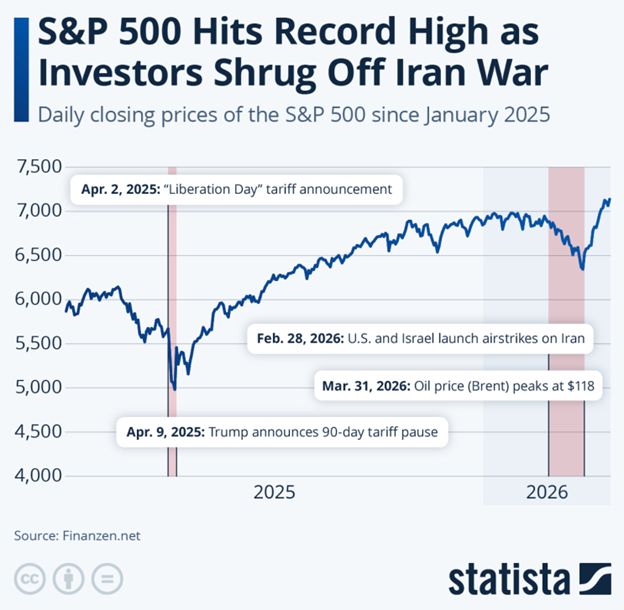 The S&P 500 is still finding new highs amid today’s uncertain market environment. Despite the Iran conflict, high inflation and heightened geopolitical tensions weighing on stocks, bullish sentiment remains high. (Source: Finanzen.net)
Pentagon documents showed that clearing mines from the Strait of Hormuz could take up to six months. Meh.
The Economist wrote that energy volatility is already “pushing the world towards the cliff edge,”… and?
For a brief moment, stocks rallied because earnings show real demand for AI exists. The disconnect between the idea of AI and the physical system that moves energy didn’t seem to matter much to traders staring at screens in Lower Manhattan.
The rally gives us a chance to get back to doing what we were doing before February 28… kvetching about the AI trade.
🧠 Zoltan Istvan on Consequences, Not Just the AI Trade
We invited Grey Swan contributor Zoltan Istvan to join for a conversation on Grey Swan Live! today.
Zoltan is even more interesting than his name would imply. At the age of 21, he set out in a motorless sailboat with the audacious goal of circumnavigating the globe. On his boat, he’d packed 500 pounds of books on philosophy, religion, literature and history.
During his journeys, he fell into the role of war-zone journalist, reporting from conflict zones for National Geographic. Only later did he run anti-poaching patrols in Southeast Asia… before returning to the U.S. to build businesses and write about how technology changes power.
He’s among the world’s foremost transhumanists and the bestselling author of The Transhumanist Wager.
As such, he’s been thinking deeply about the AI trade long before the launch of OpenAI’s ChatGPT ignited the investment frenzy on Wall Street.
In his Grey Swan work, he explained the first move in simple terms: executives told investors AI would improve productivity and reduce costs, and investors responded by buying those stocks.
Once companies start using software to replace pieces of human work, the effect doesn’t stay inside the income statement. It moves into hiring, wages, and eventually politics. That’s where the conversation shifts from earnings to consequences.
And that’s when the media starts mucking things up by misunderstanding, its profound implications and how the innovation cycle rips through the investment markets.
🤖 The Firm Is Changing, Politics Will Follow
From Zoltan’s perspective, when we look back at AI’s influence on the average American work life, we’ll be asking: “what happened?”
Internal reports, coding tasks, and routine analysis moved faster because the software handled much of the process. Work that used to take most of a day showed up, at a prompt, before lunch. That didn’t eliminate the need for people, but it changed how many were required and where they were needed.
Companies adjusted. Entry-level hiring slowed in some areas. Teams stayed smaller while output held steady. Those decisions showed up in margins, and investors rewarded them.
Investors cheered, of course. They planned elaborate retirements.
But once enough companies make that adjustment, it becomes visible outside the company. Fewer roles open up. Career paths shift. That’s when a technology story starts to turn into a labor story.
⚖️ Meanwhile, in Washington, Supply Chains and Resources Dominate The Conversation
Yesterday, the U.S. chief arbiter of trade relations, Jamieson Greer told the Financial Times that the U.S. and its allies should expect to “pay a national security premium to have a secure supply chain” for critical minerals.
Translation: just because Iran has faded from Truth Social posts and Wall Street Journal headlines for a moment doesn’t mean the shift in trade or active military conflict has gone anywhere.
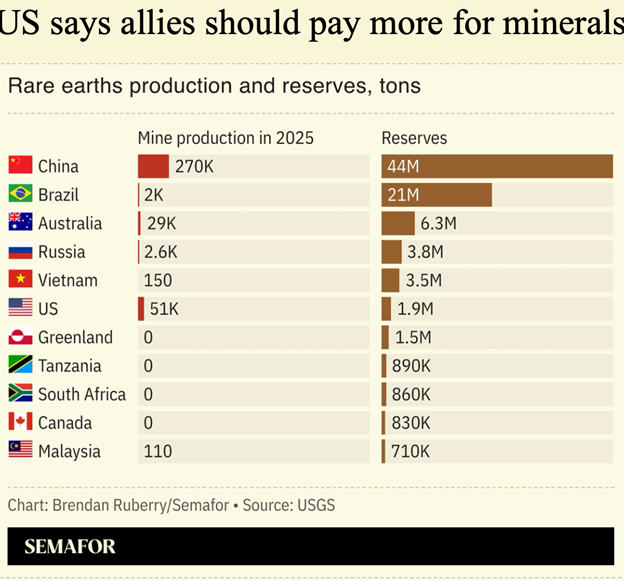 With China dominating the global rare earths market, the U.S. is calling upon its allies to step up and increase their contributions (Source: USGS)
Greer’s comment was a direct response to China’s accounting for roughly 90% of global processing capacity after decades of building out its supply chain.
The US and EU are working toward a coordinated approach to mining and pricing those materials, effectively creating a club of countries that agree to minimum prices.
Some of the U.S.’s trade partners are already worried that higher costs could ripple through to manufacturers and trigger retaliation from Beijing. The political tension doesn’t show up in a single earnings report, but it sits underneath the entire AI buildout, because those same minerals feed batteries, chips, and infrastructure; drones, missiles and aircraft carriers.
🛰 China’s Not Waiting For Markets to Decide
We also learned yesterday that a Beijing-based space startup secured $8.4 billion in financing commitments from state-linked banks to explore building orbital data centers. That’ll put them in direct competition with Musk’s impending uber-IPO SpaceX.
The Chinese timeline reportedly targets a functioning orbital data center by 2035. Their model leans heavily on direct funding and coordination between state and private firms.
The pitch for both private enterprise in the West and state funding in the East is straightforward. Data centers on Earth face limits—energy consumption, local opposition, and regulatory hurdles. Putting them in orbit avoids some of those constraints. A Voyager Technologies executive told Semafor that orbital systems could bypass “not-in-my-backyard” fights and energy bottlenecks that slow projects on the ground.
It’s another version of the same race: whoever controls the infrastructure controls the system that runs on top of it.
📱 Big Tech Is Still Working Out Where AI Actually Reaches People
There’s another layer to this that investors are starting to circle back to. The companies building models don’t automatically control distribution.
A Financial Times columnist described Apple as controlling “the technological equivalent of the Strait of Hormuz,” because its devices sit between software and the user. If AI runs through phones and laptops, whoever controls those devices controls access.
The same logic applies to Google. Even with criticism around its position in AI-powered coding, it still has billions of users who rely on its products daily. A Semafor tech editor pointed out that Google can “gobble up everyday users” simply because people are already there.
That matters because it shifts the question from who builds the best model to who owns the channel where that model gets used.
📜 We’ve Seen This Pattern Before, The Tech Is Just Better Now
It seems almost quaint today, given the high-stakes gamble going on in the Persian Gulf. On April, 23, 1975, Gerald Ford stood at Tulane University and said the Vietnam War was finished for the United States.
At that point, South Vietnamese forces were still fighting and North Vietnamese units were already moving toward Saigon. The US had been involved since the French got shellacked at the battle of Dien Bien Phu in 1954, some 20 years earlier.
 The evacuation of almost all American civilian and military personnel in Saigon, along with tens of thousands of South Vietnamese civilians who had been associated with the government. (Source: Wikipedia)
Within days, cities fell, and by April 30, tanks moved through the gates of the Presidential Palace. So much for the Cold War “Domino Theory” in that episode, eh?
Even then, the conflict was about trade and resources. But we have to invent all kinds of political narratives to convince ourselves we’re somehow on the correct side of history.
~ Addison
P.S. Last week on Grey Swan Live!, we showcased our latest research on Shadow Stocks – volatile stocks that move rapidly up and down beneath the surface of the calm indexes.
Earnings season is a ripe time for cherry-picking stocks. Along with the research, we are launching an upgrade to your Grey Swan forecast emails that will include up to five stock or trade recommendations a week.
To kick it off, we’re going to give you three stocks free of charge. Gratis. On the house. The research is excellent, and the upgraded Grey Swan Pro will be worth your time to consider. Take a look here.
And in this week’s Grey Swan Live!, Zoltan Istvan joined us to discuss how the constantly evolving AI revolution could reshape every major asset class along the way. But that’s not everything on our slate for this week.
Tomorrow, we’re going LIVE at 2 p.m. ET for our quarterly call. This unique event, available only to Grey Swan PRO members, entails a detailed review of the portfolio, covering recent allocation changes and identifying where we see the most compelling opportunities developing next.