

Micron’s earnings did not disappoint after the bell last night.
Here and in our trading fraternity live podcast yesterday, we noted Micron has become one of the purest ways to play the AI buildout. Every new data center needs memory, and memory is Micron’s business.
But semiconductors are cyclical creatures. They gallop like racehorses on the way up and stumble like drunks on the way down. Micron’s stock chart has become an uncanny mirror of Google searches for “AI bubble.”
That’s enough to make investors nervous. But there is one important difference between today’s market and the dot-com circus that reached its climax in early 2000.
In the late 1990s, investors paid fortunes for companies that generated little more than press releases. Today, the AI infrastructure leaders are producing astonishing profits:
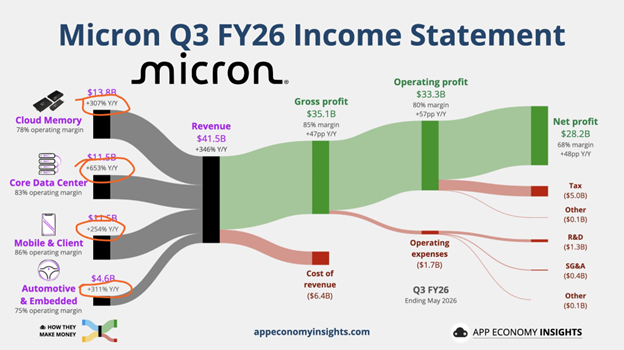
All of Micron’s divisions reported triple-digit year-over-year growth last night. (Source: App Economy Insights)
Micron’s latest results border on absurd. Every major division posted triple-digit year-over-year growth.
That’s exactly how great technology booms begin. Think back to the Internet between 1995 and 1998. The underlying innovation was real. Demand was real. Earnings were real. The speculation came later.
We’re beginning to see hints of that second act.
Hyperscalers are diverting billions from dividends and buybacks into AI infrastructure. Some are even borrowing to keep the spending spree alive.
Meanwhile, the next generation of AI companies is lining up for public offerings — even though many have yet to prove they can generate sustainable profits.
That’s the highway toward a 2000-style bust.
For now, however, earnings remain the market’s strongest defense against gravity. As long as profits continue to surprise to the upside, Wall Street can justify higher prices. JPMorgan still sees a path toward 7,800 on the S&P 500.
So, party like it’s 1998. Our forecast for a crack-up boom is very much in play. It’s a great time to buy the producers of the raw materials used to manufacture the hardware for the boom.
Today’s Grey Swan Pro also looks at a high-growth play in a commodity-related business that is seeing a surge in demand, again— details here.
Just keep in mind that every party eventually runs out of ice. After nine straight weeks of gains, investors have been accelerating down the runway.
What comes after remains a cause for concern.
~ Addison
P.S. This afternoon, we’ll host good friend and Jim Rickard’s investment strategist Dan Amoss for Grey Swan Live! You’ll want to tune in to Dan’s aggressive warning about the midterm Fed and Treasury tactics:
Grey Swan Live @ 2 p.m. EST/11 a.m. PST today, June 25, 2026.
In a brief conversation we had with Dan following Warsh’s first press conference, Dan, skeptical, explained how he believes the Fed, even under Warsh, will be forced into “financial dominance,” a fancy way of saying monetary policy will be under Trump’s thumb at least until November.