
“The intelligence of AI systems is being overhyped… those who believe artificial general intelligence (AGI) is imminent are almost certainly wrong.”
— Gary Marcus
January 27, 2025 — Remember the flash crash on August 5, 2024?
That was when traders realized that rising interest rates out of Japan, combined with upcoming interest rate cuts in the U.S., made the “yen carry trade” much less attractive.
It was like watching a speedboat slam into a sandbar — messy, loud, and entirely predictable if you’d bothered to read the tide charts.
Since then, we’ve been warning that the AI spending spree was destined to end with big traders nursing bruises the size of their egos. It wasn’t prophecy. It was common sense paired with a healthy respect for gravity.
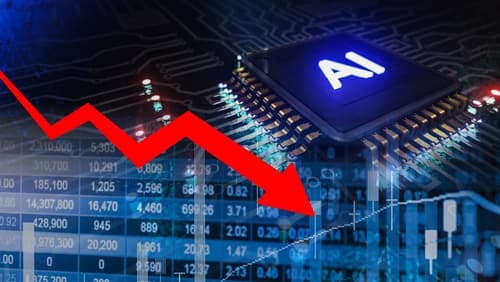
Monday made it official. Tech stocks took a nosedive after the debut of DeepSeek, China’s shiny new AI tool that spooked the market and sent Nvidia, Broadcom, and Microsoft tumbling.
The group of stocks that Wall Street had crowned the “foundation” of the market? Well, that foundation just cracked like a poorly built sandcastle at high tide.
Bloomberg:
Wall Street had a rough start to the week on concerns that DeepSeek, a cheaper AI model from China, could threaten the dominance of U.S. technology, spurring a global selloff in tech stocks.
From New York to London and Tokyo, equities got hammered, with Nvidia plunging as much as 13% and the Nasdaq and S&P both falling.
DeepSeek’s latest AI model rose to the top of Apple’s App Store charts over the weekend, presenting a visible challenge to costlier models like OpenAI and raising questions over the hundreds of billions in planned spending on the technology by the likes of Microsoft, Meta and Alphabet.

As we have cautioned since late June of last year, when Goldman Sachs first raised concerns over AI infrastructure spending at Mag 7 tech firms, notably, if you were trying to buy into tech then, you were likely buying into a bubble too high to be of much benefit to your portfolio.
Take Nvidia, 2024’s AI poster child. If you hadn’t piled into Nvidia before their May 2023 announcement of the Grace Super Chip rollout, you were already chasing the bus down the street, waving a tenner at the driver.
Don’t get us wrong. We’re all in on the AI tools hitting the market.
In fact, we spent an inordinate amount of the holiday break building an AI content engine trying to figure out, among other things, how new Large Language Module (LLM) tools can make the Grey Swan experience more efficient.
(As with all tech… the computer or even the typewriter… AI is a tool. Improved technology is no substitute for original thinking, but it does help us put together quality content in a much more efficient way.)
That said, as transformative as AI may or may not be, Nvidia was priced like it was moonlighting as the savior of humanity, a global peacemaker, and the one who finally finds Elvis alive and well in a Memphis diner.
At those heights, there was only one direction left to go — down.
Meanwhile, as everyone else was tripping over themselves to buy AI stocks, we were parking our cash in energy stocks, dividend payers, crypto, and precious metals.
Call it unsexy if you want (although crypto selloffs can make today’s selloff look like a calm day), but you don’t need to bet on the bucking bull when you can reliably milk the cow.
One cow you can count on: gold.

Sitting at all-time highs, gold is doing what gold does best: being a safe haven when everything else looks ready to implode. Measured against stocks, it’s holding its own.
“Stocks are priced to perfection,” the old-timers say. But do they ever stay that way? Of course not. Every few years, the market forgets the basics and runs headlong into the same wall.
Buy low, sell high: It’s so simple a kindergartener could grasp it, yet Wall Street treats it like ancient hieroglyphics. Instead, they buy high, sell low, and call it innovation. When Nvidia hit a trillion-dollar valuation, the warning signs couldn’t have been clearer. It’s like showing up at a wedding just as the DJ plays “Closing Time.”
Where do we go from here?
The AI hype train hasn’t derailed. It’s just pulling into Reality Station. Nvidia, Microsoft, and their peers will recover but don’t expect them to rocket back to fantasyland valuations anytime soon. And while that happens, the technology will only get better and better for its users.
Meanwhile, the money-fleeing tech needs a home. Energy stocks and dividend-payers will keep delivering, gold will remain the rock in the storm, and bitcoin will continue to stir the pot as the world waits to see who makes the next move on digital reserves.
This weekend’s correction also reminds us why sitting in cash wasn’t a bad idea. Sometimes the best move is no move, like skipping a conga line on a sticky dance floor. The key is patience, waiting for opportunities that don’t require suspending disbelief.
For now, we stick to the plan: watching, waiting, and letting the market rearrange the deck chairs. Like the quartet on the Titanic, we expect the musicians on Wall Street to keep a stiff upper lip… and play on.
For Grey Swan, as ever, it’ll be easier to enjoy when we’re not the ones scrambling for the liferaft.
Regards,

Addison Wiggin,
Grey Swan
P.S. “Addison,” writes Greg D. from Cincinnati, “Thanks for publishing the ‘collective’ email. When the author cited Musk, Trump etc, I was hoping a level field would cite Bloomberg, Soros, and Clooney, but I was left wanting.
“When arguing a point, one needs to base one’s argument on a level field. Thanks for your wisdom and thought over the years. You and Bonner hooked up at the right time.
“I have one request of you,” Greg added, “Start voting again; you can keep it secret.”
“Capitalism has its faults,” adds Jon M. “But it has worked spectacularly better than anything else man has tried. Indeed, it has created compound interest:
“Those that understand it, earn it, ….those that don’t, pay it.” – Einstein
P.P.S. Our inbox continues to fill with life and experience. We share another excerpt, this one heartfelt, from a very thoughtful Theres-Marie O’:
Fortunately, at 75, I have decades of life experience, which include 40 years of successful business ownership (sole proprietorship), the ability to travel, and the good fortune to have had many mentors along the way. I am also very
proud of the fact that I never took a business class, nor have I had the displeasure of creating or interpreting an EXCEL spreadsheet––ever! My degrees are in Psychology (minor in English) and Modern Languages (Spanish & French Literature) and they have served me well. The rules were simple––Show up on time! Answer the phone. Be nice to people. Don’t spend what you don’t have! Be neither a borrower nor a lender. Work less, do more.
My parents, also business owners, and my mother especially taught me how to use the gifts and talents I was given and how to take an idea from germination to practical reality. To be able to ’see’ what others don’t or can’t, to recognize trends and opportunities, and to translate them into a viable business is the hallmark of an entrepreneur. The recipe for a fantastic career is to realize what you can––and enjoy doing well and combine it with something you have a passion for doing. The recipe for success in that endeavor is to make sure that whatever you do it is foremost of benefit to others. It’s not about money––I have made millions over my lifetime. Work is sacred, and your individual gifts and talents are of value. Alas, the seductive messages and noise that bombards everyone online distracts from time spent introspectively, hence, the disenfranchised masses remain enslaved, unionizing en masse for the right to beg for a few dollars more. Having worked essentially on straight commission my whole life, I got so used to it––and would never ‘go back’ to an hourly wage.
Last year I retired from working for myself and still have to turn away business simply because now, my time is my own to do as I wish. As I look at the many avenues open to me, I am committed to simplifying, removing clutter, and minimizing time spent in front of a screen––or, horrors (!), multiple screens.
The trend toward ‘artificial’ anything is abhorrent to me and compounded with another trend in which morality takes a back seat, anything goes, and life is not precious, nor is the individual worth defending; it does not bode well. I know fewer and fewer people who read books, and this is another trend toward misery. The Liberal Arts Departments are struggling to exist in colleges and universities, succumbing to Science, Technology and Mathematics…. More than ever, it is the voice of the poet, the comedian even, that would appear to be drowning in the voice of the advertiser, the marketer, the snake oil salesman….try this, go ahead! As National Asset Corporations take over our ’natural assets,’ as rare earth minerals continue to be mined to exhaustion, our fields, plains, and waterways are polluted with toxins that keep on giving.
Where are we headed?
As I watch our forests burning, I cannot help but wonder if it’s deliberate – the build-back better team of ’smart communities, server farms, wind farms, solar farms’ replacing everything that went before and suborning nature to the new 4 Horsemen of the Apocalypse: Hubris, Greed, Stupidity, and Revanchism.
But who will give up their technology? I am reminded of the closing lines of a poem by Gerald Wagoner, “When Nothing Wild Remains”:
“…Vexed, you stress the significance of art as being at heart, a reactive endeavor executed by unreliable narrators, and then, you ask those present to consider, what will happen to our places of renewal after the rich buy all the mountains and nothing wild remains.”
We seem to be headed in that direction. So yes, we must break the cycle of competition and consumption. As for me, I am giving up the screen time, the cell phone is next!
What did we do before? I’ve been there, and it wasn’t so bad after all.
As always, all thoughtful reader feedback, from the pedantic to the surreal, is welcome. Send your comments to addison@greyswanfraternity.com