

GSI Banner
  • Free Access
  • Contributors
  • Membership Levels
  • Grey Swan Forecasts
  • Video
  • Origins
  • Sponsors
  • My Account
  • Sign In
  • Join Now

  • Free Access
  • Contributors
  • Membership Levels
  • Grey Swan Forecasts
  • Video
  • Origins
  • Sponsors
  • Contact

© 2026 Grey Swan Investment Fraternity

  • Cookie Policy
  • Privacy Policy
  • Terms & Conditions
  • Do Not Sell or Share My Personal Information
  • Whitelist Us
Ripple Effect

Micron, Micron, Microoon…

Addison WigginAddison Wiggin

June 24, 2026 • 2 minute, 19 second read


AIAI bubbleGoogleMicron Technologytech

Micron, Micron, Microoon…

Memory giant Micron Technology (MU) reports earnings after the closing bell today. The tech giant joined the trillionaire’s club this year on the back of a 700% surge in share price.

The demand for its product – memory chips – is tracking with the AI buildout story. But it’s also a highly cyclical part of the tech hardware market. Micron’s volatile stock chart mirrors Google search traffic for the term “AI bubble.”
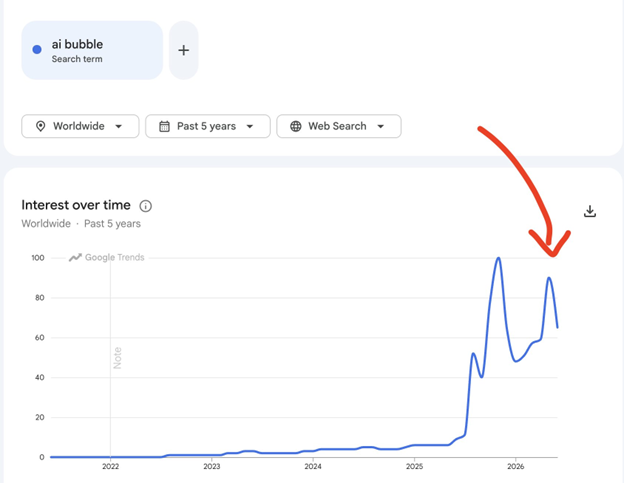
Searches for “AI bubble” are in a decline, suggesting that the market may have more room to run (Source:FX Evolution)

Much like bets on prediction sites such as Polymarket and Kalshi, Google search terms provide anecdotal data. The phrases chosen show, in real time, where sentiment lies not in price, but in what people are thinking in the real world about their money.

So far in 2026, we’ve seen two major spikes in “AI bubble” fears. That makes for some itchy trigger fingers over the sell button.

The sentiment explains, in part, why the market has shifted away from Nvidia’s (NVDA) earnings report as the most anticipated to Micron’s. 

For its fiscal third-quarter 2026 earnings report scheduled for today, Wall Street consensus expects Micron to report revenue of up to $35 billion, a nearly 280% year-over-year increase. Earnings Per Share (EPS) are expected to clock in near $20.

Today’s report should wring AI Bubble fears from market sentiment once again. 

Wall Street analysts like JPMorgan track around 41 AI-related stocks, about 8% of the S&P 500 Index’s total constituents.

However, AI-linked and AI-adjacent stocks now account for an unprecedented 53% of the S&P 500’s total market capitalization, meaning more than half the index’s performance depends on AI.

As long as the preponderance of those companies can report strong growth, the great game will continue. And so it goes…

But be cautious of the perverse psychology of market sentiment: When nobody thinks there’s a bubble… that’s precisely when the bubble will burst. We likely have another earnings season ahead of a bust. 

Today’s Grey Swan Pro reveals an oversold tech name due for a bounce. The last time it happened earlier this year, shares popped nearly 15% in a matter of weeks  — details here.  

~ Addison

P.S. Tomorrow, we’ll host good friend and Jim Rickard’s investment strategist Dan Amoss for Grey Swan Live! You’ll want to tune in to Dan’s aggressive warning about the midterm Fed and Treasury tactics:

Grey Swan Live @ 2 p.m. EST/11 a.m. PST Thursday June 25, 2026.

In a brief conversation we had with Dan following Warsh’s first press conference, Dan, skeptical, explained how he believes the Fed, even under Warsh, will be forced into “financial dominance,” a fancy way of saying monetary policy will be under Trump’s thumb at least until November. 


Copper’s Clear Signal

August 17, 2026 • Addison Wiggin

Copper and resources are sending us a cleaner market signal than AI stocks.

Channeling Ludwig von Mises, we observe this morning that price is not just a number; it’s information. Price reflects what buyers and sellers collectively believe: demand, scarcity, fear, speculation, disappointment, future expectations and available supply.

When prices rise, and inventories fall at the same time, the message is usually straightforward: buyers need the stuff, and there is not enough of it.

Copper’s Clear Signal
Market Crash Insurance Is Cheap

August 14, 2026 • Addison Wiggin

A low VIX does not predict disaster. It measures complacency. A serial skeptic will read it as the calm before a storm. We shook off that feeling this morning and opted to pursue an opportunity instead.

Here goes:

A VIX reading below 15 means the market is not pricing in much near-term trouble, even though there are obvious risks still sitting in the room: Iran, oil prices, memory chip speculation, circular financing, high valuations, epic high concentrations, spiking long-term interest rates, a regime change at the Fed, a meltdown in Japan and a historic deficit and rising national debt.

Market Crash Insurance Is Cheap
Beware: Financial Innovation In AI

August 13, 2026 • Addison Wiggin

Money is not flowing in a clean, straight line from outside investors to productive businesses. The firms at the top are investing in and buying from each other.

Microsoft and OpenAI are the easiest examples to follow.

Microsoft says OpenAI has contracted to purchase an additional $250 billion in Azure services, while Microsoft continues to account for $13 billion in funding commitments to OpenAI as an investment.

Beware: Financial Innovation In AI
Signs of a Late-Stage Bull Market

August 12, 2026 • Addison Wiggin

At this stage, it’s a stock picker’s market.

We expect space, robotics and some more visible tech startups to remain sources of speculation. After weakness in the first half of 2026, we’re also due for a strong rotation of capital into natural resources, precious metals, critical minerals and energy.

Signs of a Late-Stage Bull Market