
During its rally to a historic $122,260 on October 25, 2025, traders and crypto enthusiasts alike thought bitcoin had finally graduated from the financial fringe.
The Genius Act became law on July 18, 2025, a feat we called a “seismic shift” at the time. The Clarity Act appeared destined to follow, and big institutional money poured – Blackstone, Vanguard, Bank of America – into digital assets. Wall Street, pension funds and ETFs had finally broken the old four-year boom-and-bust cycle.
Congress had other plans.
The Clarity Act stalled in the Senate and now sits behind the Save America Act, among other sleepy summertime debates on Capitol Hill. Liquidity has tightened across the banking system and financial markets.
As a result, bitcoin resumed doing what commodity markets have always done after periods of exuberance — it corrected. Today, one bitcoin sells for $59,000 and change.
Typically, bitcoin bear markets last a year. If that’s the case, the sustainable rebound will begin in September. There’s already new supporting data in place:
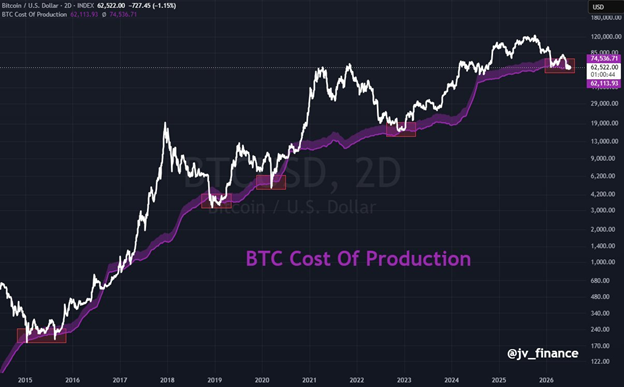
Bitcoin’s current cost of production is $74,000, significantly higher than today’s $59,000 price tag for a single coin. Prior discounts to production costs have usually signaled that bitcoin is at or near the bottom of a “crypto winter”. (Source: jv_finance via X)
Bitcoin currently costs miners roughly $74,000 to produce, fifteen grand higher than the market price.
Commodity businesses cannot tolerate that arithmetic for long. High-cost oil producers eventually cap wells. High-cost copper mines suspend operations. Bitcoin miners respond the same way. They sell reserves to pay electricity bills, service debt and keep machines running until they can’t anymore.
As weaker miners shut down, new supply slows, selling pressure fades, and the market gradually begins repairing itself. That’s why trading below the cost of production has historically marked the late stages — not the beginning — of a bitcoin bear market.
Strategy (MSTR), the largest corporate owner of bitcoin, has continued buying through the downturn, accumulating more than 847,000 coins at an average cost of roughly $75,600 each.
Financing that strategy has required billions of dollars in new equity and preferred-stock offerings, and even Michael Saylor has quietly abandoned the old “never sell” pledge by liquidating a small amount of bitcoin to help meet financing obligations.
Markets expose weak balance sheets before bad ideas. If Federal Reserve Chairman Kevin Warsh succeeds in easing financial conditions over the coming quarters, liquidity should begin returning to markets.
When it does, bitcoin’s next advance is likely to begin the same way every commodity recovery begins — not because buyers suddenly become euphoric, but because the forced sellers have finally run out of inventory.
Today’s Grey Swan Pro looks at a bitcoin-related trade unduly caught up in the current bear market that will benefit handsomely during the next bull run — details here.
~ Addison
P.S. Dan Amoss joined us last week for Grey Swan Live! Our replay is up on site for members who weren’t able to join live.
Give yourself some time to listen carefully to this one. Dan explained how the Federal Reserve, under Kevin Warsh, will be forced into “financial dominance” and provide massive liquidity to the money system this fall.
Analysts are wrong in expecting an interest-rate hike… the Fed is more likely to cut interest rates before the year is out. Dan came equipped with his top three investment recommendations for this year’s October surprise. Members will want to tune in for the replay.