

GSI Banner
  • Free Access
  • Contributors
  • Membership Levels
  • Grey Swan Forecasts
  • Video
  • Origins
  • Sponsors
  • My Account
  • Sign In
  • Join Now

  • Free Access
  • Contributors
  • Membership Levels
  • Grey Swan Forecasts
  • Video
  • Origins
  • Sponsors
  • Contact

© 2026 Grey Swan Investment Fraternity

  • Cookie Policy
  • Privacy Policy
  • Terms & Conditions
  • Do Not Sell or Share My Personal Information
  • Whitelist Us
Ripple Effect

Apocalypse Postponed

Addison WigginAddison Wiggin

April 8, 2026 • 1 minute, 41 second read


Donald TrumpIranOilS&P 500

Apocalypse Postponed

The market never took President Donald Trump’s threat to annihilate the Iranian civilization seriously. In yesterday’s trading, all three of the major indexes finished the day flat.

But traders on Wall Street sure did like the 2-week “double-sided” ceasefire announcement. Oil dropped by 20% back to $92 a barrel.

A rally in stocks started immediately following President Trump’s Truth Social post, postponing the death of Iran minutes before the 8 p.m. Eastern time deadline.

The result:
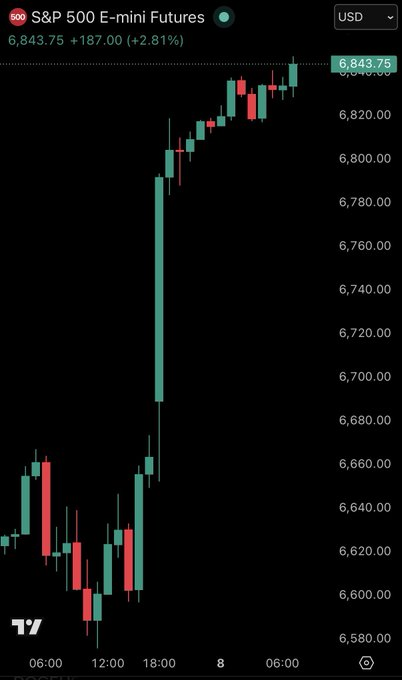
Stocks added over $1.6 trillion in value in overnight trading. (Source: The Kobeiissi Letter)

Sure, it’s annoying. Wall Street has given it the brain-dead moniker “TACO trade,” meaning  “Trump always chickens out.”

While in Hungary supporting Viktor Orbán, Vice President JD Vance is reported to have been involved in back-channel talks with China through Pakistan to organize a ceasefire with Iran.

The market cared even less about the “how” or “why” than it did about Trump’s The Art of Armageddon Truth Social Post in the first place.

By dawn, the indexes added $1.6 trillion in the futures market. 

A ceasefire isn’t peace, of course. 

Repairing global oil, natural gas and petrochemical infrastructure will take weeks, months, even years. But for now, traders on Wall Street are as giddy as the women who’d locked arms across Iranian bridges and around power plants to protect their “civilization.”

~ Addison

P.S. Grey Swan Live! Returns this week with a new guest: Dr. Mark Skousesn. Mark, also known as “America’s economist,” is a strong advocate of free-market capitalism – and a descendant of Ben Franklin.

We’re looking forward to discussing Mark’s insights as America celebrates its 250th anniversary this year – the challenges that America faces as an economic empire – and some of the top growth trends today, including the upcoming IPO of SpaceX.

We keep saying you won’t want to miss Grey Swan Live! – and we continue to mean it! Click here to sign up if you’re not already a member so you can join our latest livestream.



One Sign that Government Spending Is At a Crisis Point

August 7, 2026 • Addison Wiggin

Debts and deficits will eventually cause a crisis. Treasury Secretary Scott Bessent’s effort to help bail out the Japanese Yen this week is entirely motivated by self-preservation. The contagion signal flashing in Japanese bonds since late ‘25 is infecting the BOJ, which may be forced to sell U.S. Treasurys to stabilize its own currency.

One Sign that Government Spending Is At a Crisis Point
“Doc” Copper Tests Positive for Testosterone

August 6, 2026 • Addison Wiggin

The copper price is no doubt benefiting from inflation driven by money printing. But the doc don’t lie. Copper’s new all-time highs, while gold and silver still languish, are a sign the AI growth story is also that of the global economy itself.

“Doc” Copper Tests Positive for Testosterone
Gold Mining Stocks Still Big Winners Amid the Price Pause

August 5, 2026 • Addison Wiggin

Many miners were profitable with gold around $2,000 and silver near $50. At sustained prices closer to $4,000 gold and $60 silver, the arithmetic changes dramatically.

Gold Mining Stocks Still Big Winners Amid the Price Pause
The “Yentervention” Kicks US Markets Into High Gear

August 4, 2026 • Addison Wiggin

The stock market is getting an unexpected boost to kick off August, bucking the historically weak summer session for the U.S. stock market.

What’s happening? The Bank of Japan and the U.S. Treasury are making a coordinated effort to support Japanese yen; a move last attempted nearly 30 years in the height of the Asian Financial contagion (1998).

The “Yentervention” Kicks US Markets Into High Gear