
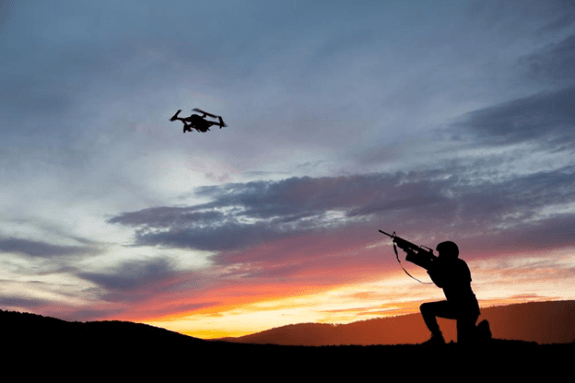
“Drones that dropped drones that released drones that then silently killed people.”
~ Brett Arquette
In just a few years, drones have
- changed the way wars are fought and won.
- negated much of the effectiveness of conventional weapons and warfare.
- made it possible for regional powers to fight larger powers successfully.
Unfortunately, these changes have put us on a path toward a global war.
To understand why, let’s dig in.
Superempowerment
Drones provide military superempowerment to anyone willing to use them. They:
- provide ~70% of the capabilities of conventional equivalents (air, sea, land, and ballistic), at a small fraction of the cost and casualty risk.
- can be assembled rapidly by using technologies and parts bought from the global commercial marketplace.
- advance in capability as quickly as the global technological landscape does (which provides improvement rates far faster than those seen in conventional weapons).
Moreover, we can expect the leverage provided by drone superempowerment to grow rapidly over time, as they fuse with low-cost, open-source AIs to become more autonomous (capable of independent decision-making in complex environments).

Rapid Onset
A big problem with drones is how fast they emerged.
- We went from handfuls of drones being used to millions in two short years (now, Ukraine produces ~10m a year and Russia ~7.3m).
- Drones quickly brought the conventional ground war to a halt (gains from offensives are measured in meters now, and Russian casualties from drones are more than 300k).
- Drones also enabled Ukraine to run an increasingly effective strategic disruption campaign targeting Russian infrastructure.
The U.S. ran into something similar when it miscalculated by starting a war with an Iran superempowered with drones.
- The US air campaign was unable to suppress Iranian drones. It was also unable to conduct naval and ground operations near Iran due to the danger posed by Iran’s drones.
- Meanwhile, Iran used drones to seize control of a critical global choke point (the Straits of Hormuz).
- Iran was also able, despite the bombing campaign, to continuously disrupt or destroy fixed US assets in the region and the assets of regional allies.
Overturning Assumptions
In two short years, drones changed key assumptions we use when fighting wars.
- A drone-armed regional power can successfully defend itself against a great power.
- Drones make conventional ground and sea operations too costly and risky to undertake (making it impossible to end the conflict quickly) and suppression operations ineffective (against a decentralized drone defense).
- Drones also allow a regional power to continuously disrupt critical infrastructure across an entire region, making it prohibitively expensive to wait out an isolated regional opponent.
Mutually Assured Disruption
The sudden arrival of drones has led to wars being fought at a distance through a relentless mutually assured disruption.
- Caught by circumstance, Russia is likely to escalate.
- It can’t end the war with Ukraine through conventional means,
- nor can it seek peace if it leaves a drone-armed foe on its border capable of strategic strikes in response to any dispute.
- Its only option is to widen the conflict by bringing Europe into the war. It won’t do this by invading with conventional forces. It will do it with drones.
- The US has a choice.
- It can’t defeat Iran through conventional warfare, which means that Iran will continue to coerce the region (i.e., charging tolls for Strait access).
- However, the US is in a unique position. The US doesn’t pay the costs of Iran’s disruption campaign in the region alone. The region and the world share the costs (high energy prices).
- This gives the US a choice. It can continue to roll the dice on conventional attempts to force Iran to submit (i.e., attacking civilian infrastructure), knowing that it won’t bear the costs of being wrong, or it can step away (the Washingtonian strategy) and let hostilities in the region gradually de-escalate.
- China is in a bind.
- Taiwan is ramping up drone production by building domestic manufacturing capacity (and sourcing assorted drones from U.S. sources). Soon, on its current track, it will achieve drone superempowerment.
- If Taiwan achieves drone superempowerment, it will become a long-term threat to China, capable of doing existential damage to the Chinese economy if hostilities occur (i.e., closing down ports and shipping).
- China’s choice: if it invades before Taiwan builds up a drone defense, it can neutralize the future threat it poses. The big risk is that if the invasion bogs down, it will give Taiwan the time it needs to ramp up drone production to millions of units. If that happens, China is in the same trap of mutually assured disruption that Russia is in today.
A World at War
If everything goes wrong:
- All three great powers will escalate, pushing for victory against their regional rivals, with little success.
- The result will be a war where drones are causing systemic disruption across all of Europe, the Middle East, and Southeast Asia.
- Due to this disruption, the global economy will shrink, inflation will soar, and political extremism will run rampant in post-national Western countries.
What it Means
Here are some twists we’ll see if this situation plays out:
- Instead of investing in traditional weapons and mobilizing personnel, countries will increasingly shift to building autonomous weapons at scale (to damage enemies from a distance). This production will increase the intensity of the war with little impact on driving a decisive outcome.
- As the costs of drone-driven attrition mount and the level of AI-fueled autonomy provided to drones improves, we’ll see frantic efforts to find new ways drones can break the stalemate with decisive military action. These efforts will eventually produce something similar to the methods outlined in the “Building Autonomous Weapons” report.
- The disruption caused by this war will result in many nations turning their AI-fueled drone arsenal inward, to control restive populations. At that point, the dreaded Long Night will be here, with AIs that control minds and drones that control bodies.
~ John Robb
Global Guerillas & Grey Swan
P.S. Right now, Wall Street’s own institutional bylaws keep the biggest funds from owning one particular stock. That changes as soon as November 10, when it could list on the Nasdaq. By then, as much as $42 billion in institutional money could be chasing it.
That means you have a narrow window to invest alongside the U.S. government and the millionaire maker himself. Grey Swan founder Addison Wiggin thinks it could turn $10,000 into $200,000 by 2028, a potential 20-bagger.
He warned about the dot-com bust and about housing in 2006, and both times Wall Street laughed. But he doesn’t think this one will be funny to anyone who sits it out.
That’s why he just went on camera to show you how to prepare to capitalize on this unique setup. Click here to get the full details.