

America is in the midst of a manufacturing job renaissance.
New factories are being built, with massive chip manufacturing facilities, like Taiwan Semiconductor’s Arizona plant, getting all the headlines.
But that’s just the media buzz. Beneath the surface, the reshoring of American jobs means more factories for vehicles, pharmaceuticals, and even defense technologies.
At a time when the labor market is sending mixed signals, the signal for manufacturing is clear:
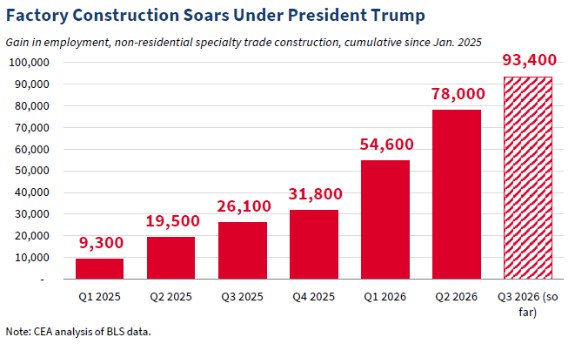
Factory construction is booming, leading to soaring construction jobs for U.S. workers. (Source: USTradeRep via X)
As with the AI data center buildout, today’s modern factories require several key commodities, copper for wiring ranking high on the list.
But even before we get that far, the real story is energy.
AI may arrive on the screen as software, but it lands in the world as a load. The International Energy Agency (IEA) expects data-center electricity demand to roughly double by 2030, growing several times faster than the rest of the power market.
The grid was not built for that kind of appetite, certainly not on the timetable now being demanded by Google, Amazon, Meta, Microsoft and the rest of the hyperscaler parade.
That is why energy has broken out of its 15-year trend, and is a growth industry again. The bottleneck is not imagination. It is transformers, turbines, generators, gas plants, nuclear contracts, switchgear, permitting, interconnection queues and the unpleasant discovery that a chatbot still needs electrons from somewhere.
The Wall Street Journal reported this morning that AI demand, equipment backlogs and grid-connection delays have already pushed power-plant construction costs higher. Reuters notes that natural gas remains difficult to displace because it can ramp quickly and use infrastructure America already has.
Even before a data center opens, it needs reliable energy. Aggreko advertises temporary power packages for data-center construction and commissioning, including diesel, gas and hybrid generators, and says it delivered a 60 MW temporary-power solution for one hyperscale project.
Caterpillar is racing to build generators for data centers. The Energy Department has even looked to backup generators at data centers as emergency grid resources.
Add reshoring as we alluded to above: Reuters also reports U.S. peak power demand could rise by 120 GW over five years, with industrial manufacturing accounting for about 24 GW of the increase.
The AI buildout is not replacing the factory story. It is arriving on top of it. Data centers, semiconductor plants, battery factories, LNG infrastructure, reshored manufacturing and electrified industry all point to the same conclusion: the new economy still runs through the old energy system.
We’re investigating three specific grid builders we like in this space. But in the meantime, we’re hyper focused on energy producers.
Today’s Grey Swan Pro recommendation looks at a company benefitting from surging AI demand in an old-school way.
~ Addison