Ripple Effect
Separating the Winners and Losers in the Second Half of 2026

June 30, 2026 • 3 minute, 44 second read

By the close today, the first half of 2026 will be in the books.
For most investors, retail and pros alike, portfolios have been rising. Despite a first-quarter dip and the annoying lack of clarity on Iran hostilities or crypto regulations, the fourth year of the bull market has been a good one, bordering on historic — and, for many investors, life changing.
The biggest surprise hasn’t been that artificial intelligence continues attracting capital. It’s where that capital has been flowing.
Two years ago, investors couldn’t buy enough shares of the “Magnificent Seven.”
Today, the market’s center of gravity has shifted upstream. The companies manufacturing the memory that feeds AI systems have become the new market leaders, as demand for high-bandwidth memory and advanced DRAM has exploded.
Every new AI server requires enormous quantities of memory, and every new data center requires thousands of those servers. That’s where spending has been leading the market thus far:
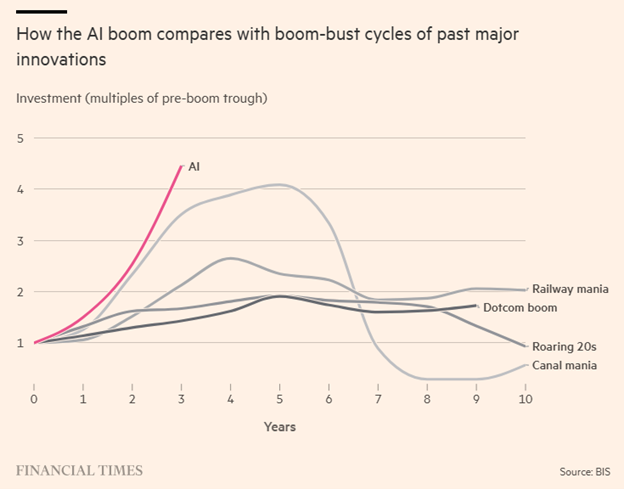
AI isn’t just surging, it’s soaring at a pace faster than other booms in history. (Source: Barchart)
The scale of the AI buildout is without precedent. Previous technology revolutions unfolded in stages. Railroads needed steel. Electrification needed copper. The Internet needed fiber-optic cable. AI requires everything all at once — memory chips, graphics processors, power plants, transmission lines, cooling systems and data centers measured not in millions, but in tens of billions of dollars.
Investors are 100% correct to worry about another bubble inflating. The more interesting question isn’t whether enthusiasm has gotten ahead of itself; it’s how much capital this new industrial buildout will consume before reality finally catches speculation.
Meanwhile, the Mag 7 companies that kicked off the AI boom have picked up a new label in the financial media: “the Lag 7.”
As you’re now aware, the AI space is so competitive and expensive that Big Tech companies like Alphabet (GOOGL), Meta Platforms (META) and even SpaceX (SPCX) have tapped the debt markets or issued new shares to finance the next round of investment.
Multitrillion-dollar companies raising new capital is a subtle but important shift. Global capital is no longer flowing to them effortlessly; they’re raising capital to keep pace with the infrastructure race.
Every industrial revolution we’ve studied rewards the companies that learn to use the new, expensive technology more efficiently than their competitors.
Railroads transformed retailers as much as railroad companies. Electricity created fortunes well beyond the utilities that generated it.
Artificial intelligence is on track to follow the same pattern.
New Chinese “open weight” platforms distributed for free are competing for end users, even as Big Tech is borrowing to fund the buildout. Brian Armstrong, the controversial CEO of Coinbase, says his company has reduced its cost of building AI systems by 50% even as productive capacity and “token usage” have increased.
The biggest winners in the second half of 2026 will be those businesses quietly lowering costs, improving productivity and widening profit margins while the industrial buildout consumes even more global capital. You’re likely to see stocks rise after earnings when and if those companies reveal how much they’ve saved on AI spending, not how much they’ve spent.
Today’s Grey Swan Pro looks at a company that’s using AI tools to rapidly scale up its revenues – yet shares are well off their highs as investors have been chasing momentum in the chip builders — details here.
~ Addison
P.S. Dan Amoss joined us last week for Grey Swan Live! Our replay is up on the site for members who weren’t able to join live here.
Analysts are wrong to expect an interest-rate hike… the Fed is more likely to cut interest rates before the year is out. Kevin Warsh is determined to overhaul Fed proceedings. At a conference of Central Bankers in Sintra, Portugal tomorrow. Expect him to talk a lot about “how” the Fed operates, not the “why” of rate decisions.
If Warsh is persuasive enough, the Warsh Fed will engage in the most radical overhaul in the bank’s 113-year history. Among the objectives he articulated before getting sworn in is an abject lowering of borrowing costs to help finance the AI intelligence economy, which now accounts for 53% of S&P 500 companies.
Mr. Amos also came equipped to Live! with his top three investment recommendations for this year’s October surprise. Members will want to tune in for the replay.

With the short holiday week ahead of America’s 250th birthday weekend, Grey Swan Live! will be back next Thursday, July 9.