
GSI Banner
  • Free Access
  • Contributors
  • Membership Levels
  • Grey Swan Forecasts
  • Video
  • Origins
  • Sponsors
  • My Account
  • Sign In
  • Join Now

  • Free Access
  • Contributors
  • Membership Levels
  • Grey Swan Forecasts
  • Video
  • Origins
  • Sponsors
  • Contact

© 2026 Grey Swan Investment Fraternity

  • Cookie Policy
  • Privacy Policy
  • Terms & Conditions
  • Do Not Sell or Share My Personal Information
  • Whitelist Us
Ripple Effect

Market Crash Insurance Is Cheap

Addison WigginAddison Wiggin

August 14, 2026 • 2 minute, 1 second read


CBOE Volatility Indexvolatility

Market Crash Insurance Is Cheap

The market is quiet. Too quiet.

Or at least, that’s what the “fear gauge” is telling us.

The CBOE Volatility Index, or VIX, uses options prices to estimate how much traders expect the S&P 500 to move over the next 30 days.

When investors are nervous, they buy protection, options prices rise, and the VIX jumps. When investors are relaxed, protection gets cheaper, and the VIX falls.

After a spike in early March when Epic Fury began in Iran, the VIX has been relatively sanguine throughout the ceasefire melodrama, starring Donald Trump from the doorway of the press room on Air Force One.

Currently, below 15, the VIX is at its lowest point this year:
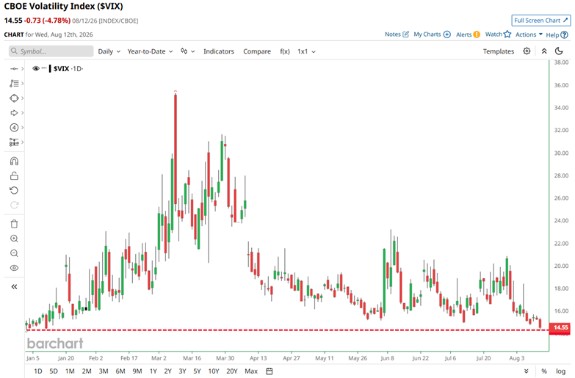
Market volatility is at its lowest level of the year, which makes it less expensive to hedge against an unexpected market decline. (Source: Barchart)

A low VIX does not predict disaster. It measures complacency. A serial skeptic will read it as the calm before a storm. We shook off that feeling this morning and opted to pursue an opportunity instead.

Here goes:

A VIX reading below 15 means the market is not pricing in much near-term trouble, even though there are obvious risks still sitting in the room: Iran, oil prices, memory chip speculation, circular financing, high valuations, epic high concentrations, spiking long-term interest rates, a regime change at the Fed, a meltdown in Japan and a historic deficit and rising national debt.

It also means investors are not paying much for protection right now.

Market calm is useful because crash insurance is cheaper when nobody thinks they need it. If the VIX is low, investors can buy market-drop hedges at a better price than during a panic.

The VIX has an “average” range of 17-20. It’s prone to spiking higher quickly, as it did back in March.

During relative calm and summer heat, the markets can get more complacent even while, as we pointed out in yesterday’s Pro, the circular AI trade meanders higher.

The market is quiet, protection is cheap… you may want to consider buying insurance before the crowd suddenly remembers why insurance exists.

Today’s Grey Swan Pro recommendation is what Andrew calls a “timing dependent” trade – and if you don’t buy crash insurance when it’s cheap, like today, it’s challenging to hedge effectively. When the inevitable market downswing begins, you’ll be happy you took out insurance ahead of time.

~ Addison

Copper’s Clear Signal

August 17, 2026 • Addison Wiggin

Copper and resources are sending us a cleaner market signal than AI stocks.

Channeling Ludwig von Mises, we observe this morning that price is not just a number; it’s information. Price reflects what buyers and sellers collectively believe: demand, scarcity, fear, speculation, disappointment, future expectations and available supply.

When prices rise, and inventories fall at the same time, the message is usually straightforward: buyers need the stuff, and there is not enough of it.

Copper’s Clear Signal
Beware: Financial Innovation In AI

August 13, 2026 • Addison Wiggin

Money is not flowing in a clean, straight line from outside investors to productive businesses. The firms at the top are investing in and buying from each other.

Microsoft and OpenAI are the easiest examples to follow.

Microsoft says OpenAI has contracted to purchase an additional $250 billion in Azure services, while Microsoft continues to account for $13 billion in funding commitments to OpenAI as an investment.

Beware: Financial Innovation In AI
Signs of a Late-Stage Bull Market

August 12, 2026 • Addison Wiggin

At this stage, it’s a stock picker’s market.

We expect space, robotics and some more visible tech startups to remain sources of speculation. After weakness in the first half of 2026, we’re also due for a strong rotation of capital into natural resources, precious metals, critical minerals and energy.

Signs of a Late-Stage Bull Market
The Energy Boom, Powering Up

August 11, 2026 • Addison Wiggin

AI may arrive on the screen as software, but it lands in the world as a load. The International Energy Agency (IEA) expects data-center electricity demand to roughly double by 2030, growing several times faster than the rest of the power market.

The grid was not built for that kind of appetite, certainly not on the timetable now being demanded by Google, Amazon, Meta, Microsoft and the rest of the hyperscaler parade.

The Energy Boom, Powering Up