
Tomorrow, SpaceX’s IPO. Today, Houston’s oil problem.
Since the late February bombing campaign against Iran, investors have been holding out for a short campaign. Every hint that the Strait of Hormuz will reopen has boosted the stock market. Every new salvo of ordinance, the opposite.
Yesterday was no exception. All three indices shed about 2% after new “defensive” strikes were carried out on ports along the Iranian coast.
Consumers, also suspending their own belief, have kept up their spending on gas and energy. To help keep prices low, the U.S. and its International Energy Agency (IEA) partners have been draining their Strategic Petroleum Reserves (SPRs):
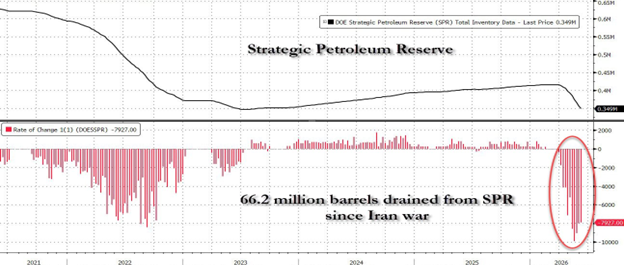
The total number of barrels released from the US Strategic Petroleum Reserve has now reached 66 million. The tanks are all but empty. (Source: ZeroHedge)
The current drawdown in the U.S. Strategic Petroleum Reserve (SPR) outpaces in speed and quantity the effort to outlast the Russian invasion of Ukraine in 2022, another conflict that was “supposed to” end quickly. Additional barrels were made to the SPR 2023 and 2025, but as you can see from the chart… not many.
The SPR was created on December 22, 1975, following the year-long oil embargo imposed by Saudi Arabia and other OPEC members. President Gerald Ford signed the Energy Policy and Conservation Act into law, setting the federal government on track to create the U.S. Department of Energy.
Following this year’s “oil shock,” the Trump administration’s aggressive sales from the SPR risk depleting reserves altogether and damaging the infrastructure itself, which is largely a cave system in Louisiana.
In new research we’re releasing tomorrow, we outline a global paradigm shift from structural disinflation to one of structural inflation. The shift is also visible in the yield for long-dated US Treasury debt. The last time markets battled structural inflation? Forty years ago, in the 1970s.
Even if an Iran peace deal is imminent, oil prices are likely to stay higher for longer. Global supply chains are already being rerouted to avoid geopolitical hotspots like the Strait of Hormuz. At $80 or more per barrel, oil companies are, for the first time in decades, reinvesting in infrastructure, production, refining and shipping.
We have the play to leverage a world of higher-for-longer oil prices; a company that soared over 1,000% during the last oil boom in the mid-2000s. You can check it out in Grey Swan Pro — details here.
~ Andrew
P.S. From oil problems in Houston, to the rocketship IPO. This afternoon on Grey Swan Live!, we’ve got our eyes on the SpaceX… just like everyone else in the investment world. If you don’t already have a position, don’t try to time an entry and exit point. The critical question for you is: What happens to the market after SpaceX?
The SpaceX IPO will be the largest in history. It’s so big that the rules governing shareholder cashouts had to be altered to accommodate new capital and protect the rest of the market.
To understand what’s really going on – and what it means for markets – we’ll bring in a friend of Grey Swan, Adam O’Dell. Adam leads the Money & Markets research group, and his system-driven approach to investing has removed much of the guesswork.
Adam just released his latest research into what the SpaceX IPO means for markets, and how investors can best position themselves not just for the IPO – but whatever happens in markets next.
Please note the special time change this week – 1 p.m. instead of 2 p.m. See you there!

If you have any questions for us, send them to Feedback@GreySwanFraternity.com.