Beneath the Surface
Gold Vs. the Everything Bubble: Victory Lap or Starting Gun?

April 22, 2025 • 4 minute, 25 second read

“Look, I can’t construct a disaster-proof portfolio. But if you’re only worried about corporate profits, panic or depression, these things don’t bother me at these prices.”
–Warren Buffett, in the 1974 bear market
April 22, 2025 — Gold hasn’t just been the year’s top performer — it’s been the decade’s stealth juggernaut.
That might sound absurd in a world drunk on tech hype and AI hysteria. But maybe not now, after a few weeks of tariff terror in the markets.
The data doesn’t lie.
Since 2020, the Nasdaq is up a respectable 89%. Thanks to a stimulus-fueled sugar rush in 2023 and 2024, the tech index managed to erase the scars of COVID and the inflation panic of 2022. Not bad.
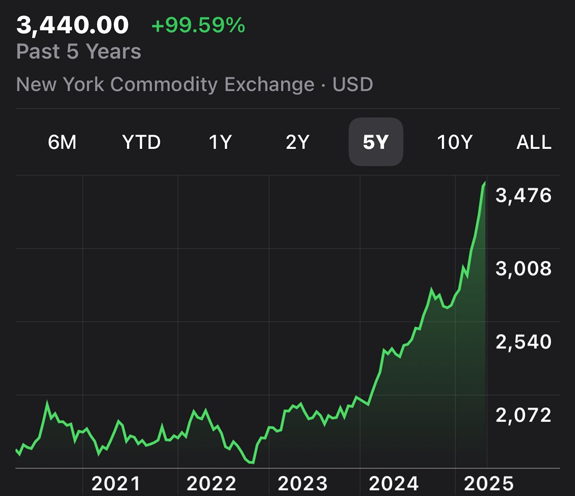
At the same time, gold is up over 99%.
A metal that does nothing. No earnings calls, no quarterly misses, no “synergies.” It just sits there… gleaming. And it’s been quietly trouncing the tech darlings of the so-called “AI revolution.”
We’ve been quietly observing and recommending gold since it was trading near $1,600. And since last summer, while mainstream pundits were still dancing around the AI bonfire, we warned tech stocks were running on fumes. Following Nvidia’s Q2 2024 earnings, we wrote:
“Even though Nvidia beat Wall Street’s expectations, it beat them by less than in the three previous quarters… that was the shot across the bow.”
Sure enough, by 2026, analysts expect Nvidia’s growth to decelerate by two-thirds. Still growing, yes — but not fast enough to feed the beast that is Wall Street’s addiction to momentum.
And yet, markets — ever the manic-depressive — rushed in anyway. Stocks climbed into year-end 2024 like Wile E. Coyote, legs spinning above the canyon floor.
In January 2025, as President Trump took his second oath of office and declared a “Golden Age of America,” our Grey Swan Bulletin offered a sober counterpoint:
“Financial markets love what they’ve heard. Stocks are roaring higher. But that could be a siren song…”
We compared the moment to Irving Fisher’s infamous 1929 quote about stocks reaching a “permanently high plateau.” The S&P 500 lost 89% by 1932. And Trump’s push for deregulation echoed the Gramm-Leach-Bliley Act — passed in 1999, right before the tech bubble popped and banking deregulation festered into the 2008 financial crisis.
As for today’s AI names? The “Magnificent Seven” now comprise 28% of the S&P 500.

Nvidia alone trades at a valuation relative to GDP that makes Cisco in the dotcom bubble look cheap. And that’s saying something.
“You thought the tech bubble was bad…”
Here’s the chart we warned about in August, updated with Nvidia’s plunge off euphoric highs over the past few weeks. It’s a nasty rhyme of 2000:

Just four months after our warning, tech stocks have made one of the fastest round-trips from record highs to a bear market in modern history.
And while tech stalls out, gold keeps ticking higher. Today’s $3,500 print isn’t just a milestone — it’s a message.
April is shaping up to be one of the worst months for stocks in a presidential term since 1928. “April is typically the third-strongest month of the year for stocks,” as our colleague Andrew Packer reminded us. This year, it’s anything but.
Yes, we could see a short-term pullback in gold. A breather after a sprint. But long-term?
Long term? You ain’t seen nothing yet.
We’re not just watching market rotation — we’re witnessing the unspooling of a decades-long global order. Trump’s controlled demolition of the post-WWII economic architecture is shaking the foundation. Tariffs that never end. Supply chains weaponized. A fiat currency system cracking under the weight of its own contradictions.
You want to know why gold is soaring? Central banks are buying it hand over fist. Not because they’re goldbugs, but because they don’t trust other central banks’ currencies… or their own.
And the supply picture? Don’t get your hopes up. New gold discoveries are as rare as fiscal restraint in Congress. As for asteroid mining? Please. That’s the crypto white paper of hard assets — futuristic fiction dressed up as frontier opportunity.
Gold isn’t rising because it’s sexy. It’s rising because trust is evaporating. And in a world where everything seems up for grabs — borders, currencies, alliances, even reality itself — gold is the one thing that doesn’t need a bailout.
So yes, we’re taking a victory lap today. But let’s be clear: this isn’t a finish line.
It’s the starting gun.
~ Addison Wiggin
Grey Swan
P.S. Our latest research on gold suggests there’s still room to go – and plenty of ways to invest in gold, including investments in gold mining stocks, which have become a standout sector in today’s fearful markets.
P.P.S: And if you’re a paid member of the Grey Swan Investment Fraternity, you can join us for a live discussion this Thursday, April 24, 2025, at 11 a.m. ET.
We’ll be analyzing the commodity space as a whole with Grey Swan Investment Fraternity contributor Shad Marquitz. We’ll cover the gamut – gold, natural gas, uranium, thorium, rare earths – you name it. It’s a can’t-miss call for members.
You can sign up here to become a member.
Add your thoughts to the mix here: addison@greyswanfraternity.com