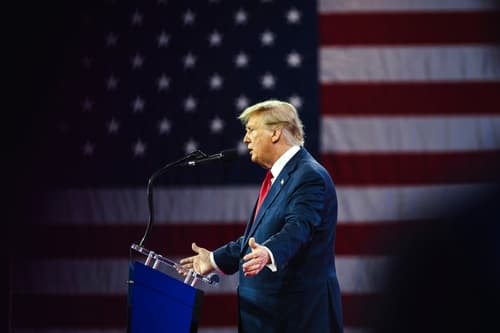
Election distrust did not arrive in 2020 wearing a red ball cap and a political slogan. But President Donald Trump did talk about it for 22 of his 27-minute address to the nation last night. No, Trump did not invent the suspicion. He has put a gold-plated escalator under it.
Depending on who you ask, his stolen election claims remain unsubstantiated. Remember this gem that circulated on social media in November 2020?

This “chart” made the rounds after the 2020 election, purportedly highlighting Joe Biden’s unusual come-from-behind victory across several swing states. It too could have been emblazoned on a ball cap or T-shirts (Source: X)
Trump was born in Queens a brawler. Early in his career, he engaged a lawyer — Roy Cohn, celebrated far and wide for his meanness and his venom— to tutor him.
“If someone hits you, you hit back 10 times as hard.” There was his code. His formula. His catechism.
“The object was to win,” Bill Bonner recalled this morning. “By what means? Whatever it takes. By piling deal upon deal. By heaping up money. By slapping his name across the face of everything that would hold paint. And when some New York scribbler pricked him early in his career, Trump fired back the immortal riposte: ‘I get more pussy than you do.’ A real gentleman, as always. The formula produced, let us say, mixed dividends.”
By any means necessary has had its political effect. Election doubt moved from the fringe into the mainstream. It had been steeping for decades in the usual American brine: collapsing trust in government, collapsing trust in media, bureaucratic arrogance, online rumor mills and a politics that now treats the other party less like an opponent than a biohazard.
The old civic trust has been leaking for a long time. Americans have spent half a century watching Washington pile up debts it cannot honestly explain, fight wars it cannot honestly win, regulate industries it barely understands, and produce public servants who somehow leave office materially richer than when they arrived.
Traditional media, once treated as the common record of public life, now looks to much of the country like another political combatant wearing a press badge. Social media amplified the grievances and organized politics around the idea that the other side is not merely wrong but illegitimate.
The pandemic made election machinery strange. Mail-in ballots expanded, rules changed, deadlines shifted, counts dragged on and election night became election week. Much of it may have been legal. That was not the problem. The problem was that voters could no longer picture the process without a flowchart, and a video post on X (formerly Twitter) of a county clerk caught with a hot mic.
P.J. O’Rourke provided a cleaner diagnosis nearly a decade before Trump entered politics. In Don’t Vote: It Just Encourages the Bastards (2010), P.J. suggested Americans have a nasty habit of treating politics like a vending machine for salvation.
No one could confuse a politician with a candidate for the priesthood. The job requires the willful commission of at least one or two venial sins a day. No, they are, at best, a necessary annoyance. Someone has to speak the slogans out loud with a straight face.
The point of elections has never been to elevate greatness. But to throw the bastards out before they get too comfortable. The real failure of elections in our time is that the bastards tend to fester in the swamp for decades.
Without Trump, America would still likely have partisan fights over voting rules. Last night, the President became the first to brand it with his name and slap it on the front panel of the bully pulpit.
Today’s Grey Swan Pro reads between the lines on Trump’s speech on election integrity, looking at one corner of the tech trade that’s quietly gaining traction right now, and could be key for far more than just election integrity — details here.
~ Addison
P.S. Yesterday on Grey Swan Live!, we returned to one of our favorite themes: Argentina’s economic turnaround. While DOGE met the Washington establishment and the establishment won, Mieli’s Argentina has truly taken a chainsaw to the administrative state.
Our man on the ground, Joel Bowman, author of Notes From the End of the World, provided a key update on what’s likely to happen next in Argentina, as well as a foreign perspective on what’s happening in the U.S. ahead of the midterm elections – election integrity or not.