
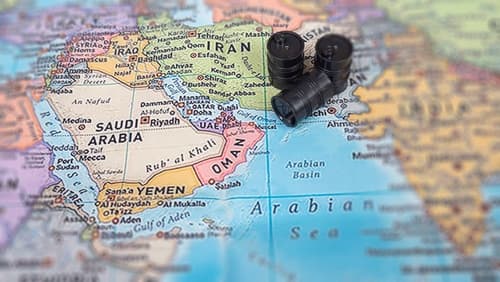
For months, we’ve been analyzing a low-grade grey swan event: tanker traffic disruption in the Strait of Hormuz, just one of the 8 choke points in global energy supply.
So far, traders have been reading headlines during Trump’s art of the cease-fire deal with little shock or awe.
Global equities are at all-time highs. Oil popped to $120 at the outbreak of the war, then has largely stabilized in the $80-90 range. Its recent push up over $100 was hammered back down yesterday.
Typically, in free markets, price sums up everything – good and bad – in one number.
The oil market during the conflict with Iran has been anything but free. To prevent catastrophic global supply shocks, the International Energy Agency (IEA) authorized a historic collective drawdown of 400 million barrels.
As a result, reserve supplies in the United States, Japan, South Korea and OECD countries have been drawn down to a historically low level.
Since their establishment by President Gerald Ford in 1975 following the Saudi oil embargo, global reserves have only been this low two times, during Operation Desert Storm and the aftermath of Hurricane Katrina.
One notable exception: China.
While it is a massive importer, China entered the current crisis in a “highly comfortable” position, having added an average of 1.1 million barrels per day to its strategic reserves throughout 2025. Its stockpiles are estimated at 1.2 to 1.4 billion barrels, allowing it to weather the current import loss without aggressively depleting its core reserves.
China’s reserves give President Xi a stacked deck in his high-stakes visit to the U.S. and trade talks with Trump today.

After 8 months of releasing supplies, the U.S. Strategic Petroleum Reserve is already inside the danger zone.
Petroleum engineers and energy analysts consider the 250 million to 300 million barrel range to be the practical operational limit. With inventories recently plunging below 293 million barrels on their way toward a projected 243 million, the reserve has officially crossed into hazardous territory.
At the current emergency extraction rate of 500,000 barrels per day, the reserve is estimated to reach its statutory floor of 252 million barrels in two months. After that, the “structural integrity floor” of 150 million barrels will be reached.
The reserves are stored in 60 giant caverns in Texas and Louisiana. The caverns are hollowed out of underground salt domes, and they rely entirely on internal liquid pressure to remain stable. If the overall fluid column drops too low, the immense geomechanical weight of the overlying earth can cause the salt walls to warp, plastically deform, or completely collapse inward.
That would be a problem.
Worst-case scenario: oil jumps quickly from a price shock to a supply shock – where it wouldn’t matter if oil were $200 or $300 – there wouldn’t be any. Major dependents on the global oil market – Indonesia, Vietnam, Pakistan, the Philippines – would be thrown into social and political chaos.
In today’s PRO, Andrew sifted through the oil infrastructure to recommend a small-cap opportunity that will weather the current oil situation and benefit handsomely from its resolution.
~ Addison
P.S. Last week on Grey Swan Live!, we welcomed back Ronan McMahon of Real Estate Trend Alert for another look at global investing — and the opportunities that exist beyond the dollar.
Ronan specializes in uncovering frontier opportunities in high-end overseas real estate, where investors can potentially find both lifestyle benefits and income.
During the presentation, he broke down the markets where prices can offer significantly more value than what you’ll find in many U.S. markets — and highlighted the types of deals that may appeal to U.S. investors looking to preserve capital while generating income.

Ronan’s real edge is his business-development strategy. Our conversation provides a fascinating look at how he structures these deals and how that approach can work in your favor if you’re interested in real estate as part of your overall investment portfolio.
It’s worth your time watching last week’s Grey Swan Live! to hear Ronan explain exactly how it works. You might also catch a glimpse of the brief interlude we took while Ronan put out a fire in his laundry! Watch the replay here.
Wait, there’s more!
Last week on the Grey Swan Trading Fraternity, we also took a closer look at the Fed’s rate hike decision last Wednesday. Did Kevin Warsh just cave big time to the banking cartel?
We examined why the economic data pointed toward another rate hike, the difficult dilemma facing policymakers, and what the decision means for our portfolio and broader strategy.

We revisited Monday’s latest trade — an income-producing strategy designed to potentially generate returns even if the market remains flat or moves sideways. You can watch a full replay of the presentation here.