

The AI boom is real. But it’s complicated.
Contrarian forensic analysts, most notably Michael Burry and George Gilder, are among a host of contrarian speculators circling the trade looking for easy carcasses to pick from.
Let’s take a look.
Mainstream financial media calls it: circular financing.
In short, money is not flowing in a clean, straight line from outside investors to productive businesses. The firms at the top are investing in and buying from each other.
Microsoft and OpenAI are the easiest examples to follow.
Microsoft says OpenAI has contracted to purchase an additional $250 billion in Azure services, while Microsoft continues to account for $13 billion in funding commitments to OpenAI as an investment.
So Microsoft is both an investor in OpenAI and a major supplier to OpenAI.
The deal is commercially rational, but it also necessitates storyboarding. And a host of very expensive law, accounting and consulting firms.
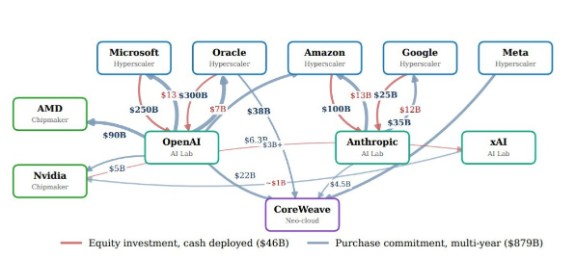
AI companies are largely investing in other AI companies, a process that appears in many cases to look like circular financing. (Source: ZeroHedge)
“Beware when lawyers and accountants start running the business…” the old timers will tell you.
This week, Nvidia and a consortium of Wall Street banks announced they’ve cobbled together a solution to attract more investor capital and keep the music playing a little longer: Make “AI compute infrastructure” a Wall Street product.
Normally, a company buys servers, chips and data-center equipment with its own cash, its own debt, or a leasing arrangement.
Here, Nvidia is working with Apollo, BlackRock, Blackstone, Brookfield, Goldman Sachs and KKR to mobilize more than $500 billion of third-party capital for AI infrastructure over time.
Nvidia says the platforms are meant to finance data centers, AI clouds, enterprise infrastructure, frontier labs and the power systems around them. The skeptic will say this is another ploy to separate investors from their savings and retirement money.
The unique part of this week’s announcement is the collateral.
Wall Street is effectively betting that Nvidia GPUs can support long-term financing the way aircraft, railcars, cell towers, real estate or pipelines do. The Financial Times describes it as a “landmark” leasing structure built on the assumption that Nvidia chips will hold enough value and generate enough customer demand to satisfy large pools of institutional capital.
The fly in the ointment for Burry and Gilder is an economic one. Chips wear out, true. The real risk is that they age financially faster than they age physically. That makes them tricky collateral.
Chips are not Treasury bonds. A pipeline, warehouse or cell tower can remain economically useful for decades. AI chips may still physically work after five years, but they can become financially stale much sooner if a new generation delivers better performance per watt, lower operating costs or faster model training.
To say nothing of a Chinese competitor dumping “similar’ chips at a much lower price. We know what happens then. In January 2025, when Deepseek dropped its first round of lower-cost superchips, Nvidia’s stock sold off 17% in a single trading session.
Today, Nvidia and Wall Street are betting that AI compute demand will stay strong enough for older GPUs to keep earning money even after the newest, cheaper chips arrive. If that bet is wrong, the “asset class” starts looking less like infrastructure and more like financed electronics with a very expensive fan club.
While the club is still bumping and grinding, today’s Pro recommendation is in the business of making the Nvidia model sustainable.
In 2026, the company closed an $8.5 billion investment-grade GPU-backed financing facility. Then followed that up with a $3.1 billion publicly syndicated HPC-backed “delayed-draw” term loan tied to customer contracts; the first publicly syndicated HPC-backed delayed-draw term loan facility, and said it received strong investor demand.
Financial innovation at its finest!
In plain English: the company is the pawn shop, landlord and borrower in the AI gold rush. Nvidia sells the picks and shovels. Wall Street lends against the shovels. OpenAI and Meta rent the shovels. The rental contracts justify buying more shovels.
Everybody looks rich as long as the mine keeps producing. Everyone’s happy as long as the wonks and bean counters can keep it all straight.
Historically speaking, in 1999-2000, when “financial innovation” became the narrative on Wall Street, the bust was only months away. In the meantime, there’s likely room near the blow off top for some quick gains.
Today’s Grey Swan Pro recommendation is a speculative play on the AI space, one that’s getting funds — but isn’t yet paying out — on this landmark leasing deal.
~ Addison